In Mozambique, Sun Biofuels exported its first shipment of biofuel produced from jatropha to be used by the German airline Lufthansa.
Thirty tons of jatropha oil produced in Mozambique’s central province of Manica were crushed by British company Sun Biofuels and sent to Germany. Luftansa is currently seeking 400 million liters of biofuels globally as part of the Company’s move toward mitigating high-cost petroleum and greenhouse gas emissions.
In Borneo, Mitsubishi and the Sarawak Biodiversity Centre will collaborate in exploring algal biodiversity as a possible source of renewable energy. SBC’s work has expanded over the last six years from long term pharmaceutical projects, to shorter term projects in areas such as biotechnology.
Furthermore,in Indonesia, Molindo Raya Industrial announced plans to construct a 55-million liter/year ethanol plant in 2012, following recent land acquisition for the project.
When completed in 2013, the $40-50 million plant will double the Company’s ethanol production capacity using molasses feedstock sourced from a nearby sugar mill.
The company currently owns another 55-million liter/year molasses-based ethanol plant in Lawang, East Java. Approximately 18% (10 million liters/year) of the plant’s ethanol production is anhydrous or fuel-grade ethanol, while the rest is hydrous ethanol used for industrial or pharmaceutical purposes.
Tuesday, July 26, 2011


Friday, July 22, 2011
How are we going to get from 6.6 million gallons in 2011 to 20 BILLION gallons in 2022?
Here’s how:
By bringing the industry together: At the Advanced Biofuels Markets congress you will hear from CEOs and Presidents who are driving the development of Advanced Biofuels and who will get us to the RFS target, speakers will include Advanced Biofuels Company Executives, Venture Capitalists & Investment Bankers, Corporate Strategic Investment and Alliance Executives, EPC firms and industry suppliers. If you are responsible for making decisions in this sector, you need to be here.
By not going it alone: To reach this goal the industry has to work in concert –networking to build new relationships, catching up with buddies, partnering and collaborating are the key to success. As Jim Lane (Biofuels Digest) always says ‘Go out there and network like crazy!’ For most of you networking is the most important reason to attend an event, so for 2011 we are actually having an entire day dedicated to structured networking: roundtables, one to one meetings and speed networking. No other biofuels event offers this comprehensive chance to have a conversation with literally every conference attendee (450 expected). That equates to 20 hours over 3 days
By knowing what technologies and services to use: To achieve the RFS targets, the industry needs to produce viable, commercial-scale advanced biofuels. What technologies are working? Which companies can help you achieve your goals? What support services are available out there? Our Exhibition Hall will be the hub for networking and business development, giving you a chance to network with exhibitors, hear about their products and understand your needs.
Meanwhile in India, Eco Green Fuels and World Health Energy has signed a LOI for a comprehensive joint venture to provide 1 million liters of algal oil to EFG by the last quarter of 2012.
World Health Energy Holdings, Inc. recently acquired GNE-India, an algae technology company with the distribution and licensing rights to a unique and innovative technology, the GNE GB 3000 system, to grow algae quickly and efficiently for the production of biodiesel and commercial fish food protein.
source:http://www2.greenpowerconferences.co.uk/EF/?sSubSystem=Prospectus&sEventCode=BN1111US&sSessionID=d449afda8908fbb317314c318b883027-3036717
By bringing the industry together: At the Advanced Biofuels Markets congress you will hear from CEOs and Presidents who are driving the development of Advanced Biofuels and who will get us to the RFS target, speakers will include Advanced Biofuels Company Executives, Venture Capitalists & Investment Bankers, Corporate Strategic Investment and Alliance Executives, EPC firms and industry suppliers. If you are responsible for making decisions in this sector, you need to be here.
By not going it alone: To reach this goal the industry has to work in concert –networking to build new relationships, catching up with buddies, partnering and collaborating are the key to success. As Jim Lane (Biofuels Digest) always says ‘Go out there and network like crazy!’ For most of you networking is the most important reason to attend an event, so for 2011 we are actually having an entire day dedicated to structured networking: roundtables, one to one meetings and speed networking. No other biofuels event offers this comprehensive chance to have a conversation with literally every conference attendee (450 expected). That equates to 20 hours over 3 days
By knowing what technologies and services to use: To achieve the RFS targets, the industry needs to produce viable, commercial-scale advanced biofuels. What technologies are working? Which companies can help you achieve your goals? What support services are available out there? Our Exhibition Hall will be the hub for networking and business development, giving you a chance to network with exhibitors, hear about their products and understand your needs.
Meanwhile in India, Eco Green Fuels and World Health Energy has signed a LOI for a comprehensive joint venture to provide 1 million liters of algal oil to EFG by the last quarter of 2012.
World Health Energy Holdings, Inc. recently acquired GNE-India, an algae technology company with the distribution and licensing rights to a unique and innovative technology, the GNE GB 3000 system, to grow algae quickly and efficiently for the production of biodiesel and commercial fish food protein.
source:http://www2.greenpowerconferences.co.uk/EF/?sSubSystem=Prospectus&sEventCode=BN1111US&sSessionID=d449afda8908fbb317314c318b883027-3036717
Friday, July 15, 2011
PNG urgently needs replacement fuels
The need for replacement fuels.
The need for energy has grown drastically proportional to population growth, and 21st century energy demands have been very high based on global demands analysis. That growth will elevate even higher as world population doubles as near as 2050. Every day, hundreds of millions of tons of energy sources are burned to produce to sustain human activities. Should that activity be industries, transport or power generation such as coal for electricity, one way or the other, non renewable energy sources has been exploited at a faster rate. This trend is unhealthy for the future generation, environment and energy sustainability. Putting perspective into reality, non renewable energy such as fossil petroleum cannot sustain the world in the next hundred year period. The desperate need to sustain energy supply to meet demands resulted in energy companies putting over billion dollars in renewable energy production, some of the major energy players such as Exxonbil, Origin energy, BP has in the recent times invested heavily in biofuels. What is the big fear? Those lucky oil rich regions will play fuel war putting majority into social chaos. To be more clear, those lucky rich will have the upper hand to dictate our economics, politics and our development. Is that far-fetched or for real?
The powerless ICCC of PNG,is good at reporting fuel price from time to time in the daily papers, besides they can do nothing. The reality is as worse can one see from outside PNG. Fuel price constant warning is pushing goods and services prices higher each day coupled with government taxes, a certain good doubles in prices as it moves away from the town/cities. The manifestation in magnitude does not need a research scientist from National Research Institute (NRI) to reveal the trend, its already and and at its worse.
Petrol, diesel, kerosene, methane, propane and even aviation fuel prices has increased prices in the past six months. Public and private institutions have over these periods gone to tip-tuck trying to adjust and sustain operations and in many cases let loose this tsunamic economic stress to the masses causing huge economic struggles among PNG nationals at all levels. Many learning institutions, at least the secondary schools have been reported to be using firewood to fuel cooking three times a day. Kerosene and gas stoves are very expensive to utilize. Asaroka Lutheran Secondary in the Eastern Highlands province, I last attended in 1997 has been reported to resort to firewood according to Ezekiel Gene who is my brother who last attended in 2010. Unfortunately, school administration will pass increase tuition fee to parents to meet high energy price. Other learning institutions have no options, unless the government is smarter.
As a graduate Bioenergy, during my study years in China I have encountered Chinese biofuels energy self reliance, that is they have no foreign monopoly on their fuel supply. Most restaurants and household would use solid briquette or carbonized fuel and methane gas. These fuels are produced by local industries and supplied locally, kerosene, propane and fuel shortages have been drastically minimized to no market for them in most of China. What fuels do the 1.3 billion population cook for their feed? biofuels! These fuels are not new concept, researches revealed that in the past 60 years, more than 73% of the Chinese population have been using methane produced locally, and since then 80% or more are using methane in their homes. Home methane production is a norm and local government assist the populace to fully develop local energy concepts and that’s Biofuels.
The other is the solid fuel or the carbonized cellulosic fuel or pressed and glued called briquette. Most restaurants in China uses this fuel and is a huge industry, Kerosene, I have not encountered one and seems intelligent Chinese eradicated it or so I assume.
With hands-on, reality experience and encounters with chinese in China, the bioenergy processing and with studies and researches, I have no doubt that the solid energy industry would satisfy PNG. Papua New Guinea can drastically reduce kerosene and cooking gas dependency.
In this article, I would like to lower the veil to reveal what dynamic solid fuel opportunity is at our disposal, furthermore, will expound some brief processing details for potential developers in PNG.
Cellulose materials such as wood, leaves, barks, roots, shrubs, timber wastages such as from industries, agro wastes are the potential raw materials for solid fuel production. These cellulosic materials need to be converted to carbon. Just how can that be done? That is a good question for beginners, the carbonizations of these materials need burning, however, this burning is controlled to accommodate carbon formation. First you need a combustion chamber, this chamber is designed to permit limited oxygen , this limited oxygen burning will directly facilitate cellulosic materials to dark carbonous material formation. From this stage, the carbonized material or the solid fuel can be used directly or further processed to briquette.
Briquette processing is not a new technology; it has been developed and used, marketed worldwide and widely accepted as fuel equivalent to kerosene or gas. The carbonized material lacks gluing agent and is itself unable to give a compact solid feature for cooking. This material is first grounded so can be pressed and glued using specialized flammable glue. Briquette can be pressed into different sizes depending on the stove design, demand and operational ability/capacity.
The most important part to solid fuel development, marketing and utilization is its stove design and external hybrid system. The carbonized cellulose and briquette are compact energized solid fuel unlike liquid fuel. This means they need specialized design to easily burn off, the design and its burning system must make sure enough air is supplied. The stove can be designed to hold pots and pans either single or two with ranging sizes from 3 kg to 50kg cooking capacity, a metallic structure resembling a bowl so that the carbonized fuel or the briquette can be placed at the bottom. Further down the bottom of the bowl you have to accommodate the air ventilation. There are two mechanisms for air supply, first is the natural air current where as hot air moves out, cold air comes in blowing the furnace to facilitate burning. The most efficient would be the electrical-mechanical blowing by means of blower. The blower can vary depends on the size of the stove, use and kind of pan to facilitate cooking. The blower is placed at the bottom of the stocked solid fuels and motors the blowing into glowing flamed coal like matter. The heat content of the solid fuel is nearer than the methane and propane. The compacted solid fuel releases much heat per gram since being compacted, the gnawing oxygen rich air promotes efficient burning which furiously cooks food in less time.
My solid biofuels hybrid system is when the system is attached to a solar powered blower. The stove with solid fuel, solar powered blower is truly a design that is compactable to suit our current fuel need. Cities and towns need that system, a little power and a little solid fuel is just enough to serve three 3 or more pots of food.
My former high school, Asaroka Secondary, an institution vital for the development of this likewise other schools nationwide will go to firewood or other undeveloped alternative fuel source or simply pass higher tuition fees directly putting load on many poor parents. Unfortunately, PNG will have to put up with high fuel cost because government is not thinking. However, I am open to provide technical support and advice to any potential developers and investors for the good of the people and the nation as a whole.
The author was a freelance consultancies in solid, liquid and gas bioenergies for clients in Yemen, India and the USA. He specializes also in algae biofuels (biodiesel, ethanol, and methane), syn gas, methanol, and starch conversions, waste to energy, solid fuel development, digester designs, and stove and biofuels instrumentations.
Gene Drekeke Iyovo , Msc, Bsc
Occupation: Engineer, Bioenergy.
The need for energy has grown drastically proportional to population growth, and 21st century energy demands have been very high based on global demands analysis. That growth will elevate even higher as world population doubles as near as 2050. Every day, hundreds of millions of tons of energy sources are burned to produce to sustain human activities. Should that activity be industries, transport or power generation such as coal for electricity, one way or the other, non renewable energy sources has been exploited at a faster rate. This trend is unhealthy for the future generation, environment and energy sustainability. Putting perspective into reality, non renewable energy such as fossil petroleum cannot sustain the world in the next hundred year period. The desperate need to sustain energy supply to meet demands resulted in energy companies putting over billion dollars in renewable energy production, some of the major energy players such as Exxonbil, Origin energy, BP has in the recent times invested heavily in biofuels. What is the big fear? Those lucky oil rich regions will play fuel war putting majority into social chaos. To be more clear, those lucky rich will have the upper hand to dictate our economics, politics and our development. Is that far-fetched or for real?
The powerless ICCC of PNG,is good at reporting fuel price from time to time in the daily papers, besides they can do nothing. The reality is as worse can one see from outside PNG. Fuel price constant warning is pushing goods and services prices higher each day coupled with government taxes, a certain good doubles in prices as it moves away from the town/cities. The manifestation in magnitude does not need a research scientist from National Research Institute (NRI) to reveal the trend, its already and and at its worse.
Petrol, diesel, kerosene, methane, propane and even aviation fuel prices has increased prices in the past six months. Public and private institutions have over these periods gone to tip-tuck trying to adjust and sustain operations and in many cases let loose this tsunamic economic stress to the masses causing huge economic struggles among PNG nationals at all levels. Many learning institutions, at least the secondary schools have been reported to be using firewood to fuel cooking three times a day. Kerosene and gas stoves are very expensive to utilize. Asaroka Lutheran Secondary in the Eastern Highlands province, I last attended in 1997 has been reported to resort to firewood according to Ezekiel Gene who is my brother who last attended in 2010. Unfortunately, school administration will pass increase tuition fee to parents to meet high energy price. Other learning institutions have no options, unless the government is smarter.
As a graduate Bioenergy, during my study years in China I have encountered Chinese biofuels energy self reliance, that is they have no foreign monopoly on their fuel supply. Most restaurants and household would use solid briquette or carbonized fuel and methane gas. These fuels are produced by local industries and supplied locally, kerosene, propane and fuel shortages have been drastically minimized to no market for them in most of China. What fuels do the 1.3 billion population cook for their feed? biofuels! These fuels are not new concept, researches revealed that in the past 60 years, more than 73% of the Chinese population have been using methane produced locally, and since then 80% or more are using methane in their homes. Home methane production is a norm and local government assist the populace to fully develop local energy concepts and that’s Biofuels.
The other is the solid fuel or the carbonized cellulosic fuel or pressed and glued called briquette. Most restaurants in China uses this fuel and is a huge industry, Kerosene, I have not encountered one and seems intelligent Chinese eradicated it or so I assume.
With hands-on, reality experience and encounters with chinese in China, the bioenergy processing and with studies and researches, I have no doubt that the solid energy industry would satisfy PNG. Papua New Guinea can drastically reduce kerosene and cooking gas dependency.
In this article, I would like to lower the veil to reveal what dynamic solid fuel opportunity is at our disposal, furthermore, will expound some brief processing details for potential developers in PNG.
Cellulose materials such as wood, leaves, barks, roots, shrubs, timber wastages such as from industries, agro wastes are the potential raw materials for solid fuel production. These cellulosic materials need to be converted to carbon. Just how can that be done? That is a good question for beginners, the carbonizations of these materials need burning, however, this burning is controlled to accommodate carbon formation. First you need a combustion chamber, this chamber is designed to permit limited oxygen , this limited oxygen burning will directly facilitate cellulosic materials to dark carbonous material formation. From this stage, the carbonized material or the solid fuel can be used directly or further processed to briquette.
Briquette processing is not a new technology; it has been developed and used, marketed worldwide and widely accepted as fuel equivalent to kerosene or gas. The carbonized material lacks gluing agent and is itself unable to give a compact solid feature for cooking. This material is first grounded so can be pressed and glued using specialized flammable glue. Briquette can be pressed into different sizes depending on the stove design, demand and operational ability/capacity.
The most important part to solid fuel development, marketing and utilization is its stove design and external hybrid system. The carbonized cellulose and briquette are compact energized solid fuel unlike liquid fuel. This means they need specialized design to easily burn off, the design and its burning system must make sure enough air is supplied. The stove can be designed to hold pots and pans either single or two with ranging sizes from 3 kg to 50kg cooking capacity, a metallic structure resembling a bowl so that the carbonized fuel or the briquette can be placed at the bottom. Further down the bottom of the bowl you have to accommodate the air ventilation. There are two mechanisms for air supply, first is the natural air current where as hot air moves out, cold air comes in blowing the furnace to facilitate burning. The most efficient would be the electrical-mechanical blowing by means of blower. The blower can vary depends on the size of the stove, use and kind of pan to facilitate cooking. The blower is placed at the bottom of the stocked solid fuels and motors the blowing into glowing flamed coal like matter. The heat content of the solid fuel is nearer than the methane and propane. The compacted solid fuel releases much heat per gram since being compacted, the gnawing oxygen rich air promotes efficient burning which furiously cooks food in less time.
My solid biofuels hybrid system is when the system is attached to a solar powered blower. The stove with solid fuel, solar powered blower is truly a design that is compactable to suit our current fuel need. Cities and towns need that system, a little power and a little solid fuel is just enough to serve three 3 or more pots of food.
My former high school, Asaroka Secondary, an institution vital for the development of this likewise other schools nationwide will go to firewood or other undeveloped alternative fuel source or simply pass higher tuition fees directly putting load on many poor parents. Unfortunately, PNG will have to put up with high fuel cost because government is not thinking. However, I am open to provide technical support and advice to any potential developers and investors for the good of the people and the nation as a whole.
The author was a freelance consultancies in solid, liquid and gas bioenergies for clients in Yemen, India and the USA. He specializes also in algae biofuels (biodiesel, ethanol, and methane), syn gas, methanol, and starch conversions, waste to energy, solid fuel development, digester designs, and stove and biofuels instrumentations.
Gene Drekeke Iyovo , Msc, Bsc
Occupation: Engineer, Bioenergy.
Tuesday, June 1, 2010
Latest Biofuel news around the world
Last week, BP committed $500 million in a ten-year year research program to study "the impact of the Deepwater Horizon incident, and its associated response, on the marine and shoreline environment of the Gulf of Mexico." It recalls the $500 million BP invested in 2007 in the Energy Bioscienes Institute. Deepwater indeed for the oil industry this year - but if there are deep troubles, there are deep pockets.
Pockets are a little smaller around the biofuels industry, where this past week in Washington, four of the companies which have received investment support from oil majors or have formed investment partnerships with them - Coskata (Total), HR Biopetroleum (Shell), Solazyme (Chevron), Algenol (Valero), visited with reporters to discuss "the industry's #1 ask" this political season: the need for sustained and diverse tax credits.
Their goal, to develop "parity with solar and wind" in a tax credit design that unleashed billions in investment for other renewables from private equity.
But - private equity, schmequity. The $500 million committed by BP this week to studying the impact of Deepwater Horizon would have funded virtually any first-in-kind advanced biofuels project currently stalled for lack of finance, many of them already receiving investment from the oil industry and seeking, through "#1 asks" like HR 5412, to deploy their technologies at scale.
In the wake of the massive Gulf of Mexico oil spill, it’s clear the U.S. needs to end its crude-oil addiction as much to protect its economy as the environment.
To move the future forward, America needs one company in particular to come through on behalf of all Americans. In a cruel twist of fate, that company is ExxonMobil (XOM), which is working on arguably the most important energy-research project in the world today. Namely, a project to replace crude with genetically-modified algae that can be cost-effectively refined using existing refinery equipment.
A year ago when Exxon announced its algae project with biotech pioneer J. Craig Venter, the company said that it would take at least 5-10 years to produce commercial quantities of algae-based fuels. “My suspicion, and it’s just a suspicion, is that they still see it as five to 10 years away,” says Addison Wiggin, editorial director of The Daily Reckoning, who has been looking into the Exxon-Venter project for a forthcoming documentary on entrepreneurs in the post-crisis financial world.
Too long. As video of the black death pouring out of that ruptured pipeline gushes onto every American TV and computer screen, it's time for President Obama to declare a new Manhattan Project, a new man-to-moon space race. The goal must be to take America off its crude addiction in less than five years with a literally home-grown industry that will create tens of thousands of agricultural and other jobs without jeopardizing the existing oil industry’s trillion-dollar infrastructure.
Exxon shares would surge the moment this plan became publicly known; however, the President can’t allow the investor payoff to be too bountiful. There will have to be safeguards against Exxon controlling the applicable patents in order to prevent the company from controlling America’s energy future.
Algae oil is no panacea, the President will further need to say. Accelerated development of plug-in electric and all-electric vehicles is needed in order for the U.S. to have, by 2020 or sooner, a nationally-secure, environmentally-sound transportation infrastructure.
In a second twist of fate, not only would Exxon shares likely surge in price, so too might the shares of utilities that generate a lot of electricity from coal. Companies such as Duke Energy (DUK), Southern (SO) and FirstEnergy (FE) might lose their pariah image if part of the President’s strategy were to capture coal plants’ carbon dioxide and use it to accelerate algae growth.
For risk-inclined investors who believe that all this may be on the way, a company that might be worth a closer look right now is tiny OriginOil. (OOIL.OB). The company has started signing up customers as it begins commercializing a technology for producing biofuel from algae using CO2 emissions captured from smokestacks.
International news:
In Canada, the Canadian Renewable Fuels Association released a report on the Total Economic Impact Assessment of Biofuels Plants in Canada, which found that the construction of 28 renewable fuels plants in Canada generated $2.949 billion in economic activity. The construction activity created 14,177 direct and indirect jobs during the respective construction periods.
In Australia, Mission NewEnergy Limited (ASX: MBT) announced that the commissioning of its second 75 Mgy Axens 2nd Generation biodiesel trans-esterification refinery has been completed. Mission expects to begin producing under its Valero contract once the U.S. Environmental Protection Agency has accepted palm oil as an approved pathway, and makes palm oil biodiesel eligible for Renewable Identification Number (RINS).
In Barbados, Amelot Holdings and Barbados National Oil Company have signed an MOU for the ownership and operation of a biodiesel production facility, using waste cooking oil as a feedstock. BNOCL also plans to develop B20 pumps for biodiesle distribution. The facility will use containerized modular equipment and proprietary feedstock technology.
Pockets are a little smaller around the biofuels industry, where this past week in Washington, four of the companies which have received investment support from oil majors or have formed investment partnerships with them - Coskata (Total), HR Biopetroleum (Shell), Solazyme (Chevron), Algenol (Valero), visited with reporters to discuss "the industry's #1 ask" this political season: the need for sustained and diverse tax credits.
Their goal, to develop "parity with solar and wind" in a tax credit design that unleashed billions in investment for other renewables from private equity.
But - private equity, schmequity. The $500 million committed by BP this week to studying the impact of Deepwater Horizon would have funded virtually any first-in-kind advanced biofuels project currently stalled for lack of finance, many of them already receiving investment from the oil industry and seeking, through "#1 asks" like HR 5412, to deploy their technologies at scale.
In the wake of the massive Gulf of Mexico oil spill, it’s clear the U.S. needs to end its crude-oil addiction as much to protect its economy as the environment.
To move the future forward, America needs one company in particular to come through on behalf of all Americans. In a cruel twist of fate, that company is ExxonMobil (XOM), which is working on arguably the most important energy-research project in the world today. Namely, a project to replace crude with genetically-modified algae that can be cost-effectively refined using existing refinery equipment.
A year ago when Exxon announced its algae project with biotech pioneer J. Craig Venter, the company said that it would take at least 5-10 years to produce commercial quantities of algae-based fuels. “My suspicion, and it’s just a suspicion, is that they still see it as five to 10 years away,” says Addison Wiggin, editorial director of The Daily Reckoning, who has been looking into the Exxon-Venter project for a forthcoming documentary on entrepreneurs in the post-crisis financial world.
Too long. As video of the black death pouring out of that ruptured pipeline gushes onto every American TV and computer screen, it's time for President Obama to declare a new Manhattan Project, a new man-to-moon space race. The goal must be to take America off its crude addiction in less than five years with a literally home-grown industry that will create tens of thousands of agricultural and other jobs without jeopardizing the existing oil industry’s trillion-dollar infrastructure.
Exxon shares would surge the moment this plan became publicly known; however, the President can’t allow the investor payoff to be too bountiful. There will have to be safeguards against Exxon controlling the applicable patents in order to prevent the company from controlling America’s energy future.
Algae oil is no panacea, the President will further need to say. Accelerated development of plug-in electric and all-electric vehicles is needed in order for the U.S. to have, by 2020 or sooner, a nationally-secure, environmentally-sound transportation infrastructure.
In a second twist of fate, not only would Exxon shares likely surge in price, so too might the shares of utilities that generate a lot of electricity from coal. Companies such as Duke Energy (DUK), Southern (SO) and FirstEnergy (FE) might lose their pariah image if part of the President’s strategy were to capture coal plants’ carbon dioxide and use it to accelerate algae growth.
For risk-inclined investors who believe that all this may be on the way, a company that might be worth a closer look right now is tiny OriginOil. (OOIL.OB). The company has started signing up customers as it begins commercializing a technology for producing biofuel from algae using CO2 emissions captured from smokestacks.
International news:
In Canada, the Canadian Renewable Fuels Association released a report on the Total Economic Impact Assessment of Biofuels Plants in Canada, which found that the construction of 28 renewable fuels plants in Canada generated $2.949 billion in economic activity. The construction activity created 14,177 direct and indirect jobs during the respective construction periods.
In Australia, Mission NewEnergy Limited (ASX: MBT) announced that the commissioning of its second 75 Mgy Axens 2nd Generation biodiesel trans-esterification refinery has been completed. Mission expects to begin producing under its Valero contract once the U.S. Environmental Protection Agency has accepted palm oil as an approved pathway, and makes palm oil biodiesel eligible for Renewable Identification Number (RINS).
In Barbados, Amelot Holdings and Barbados National Oil Company have signed an MOU for the ownership and operation of a biodiesel production facility, using waste cooking oil as a feedstock. BNOCL also plans to develop B20 pumps for biodiesle distribution. The facility will use containerized modular equipment and proprietary feedstock technology.
Thursday, May 27, 2010
Offshore Oil Disaster Could Boost New-Age Biofuels

Gulf of Mexico oil spill has dimmed the prospects for new offshore oil drilling, next-generation biofuels may be able to compensate for that lost production, marking the start of a bigger move away from oil.
Crisis in the Gulf
"Six-billion dollars goes a long way,” says one energy fund portfolio manager, referring to one estimate of the oil spill’s final cost. “With the right amount of investment [in biofuels], eventually the need for new [fossil fuel] production drops at some point. Is it $6 billion? I don’t know.”
Biofuels like ethanol and biodiesel have been commercially available for some time, mandated by various laws and regulations, but are usually blended with their fossil-fuel-derived counterparts.
Next-generation biofuels in the development pipeline now use different processes to create fuels from renewable feedstocks—animal fats and algae for example—that are chemically identical to the products created from petroleum.
Known as “drop-in fuels", they can be put directly into gas tanks and burned like fossil-fuel gasoline and diesel, with no equipment modifications or blending needed.
“There’s no need to rebuild the entire infrastructure” says Advanced BioFuels Association president Michael McAdams, a trade organization representing biofuels developers. “It could be $20 billion to retrofit the market for (more) corn-based ethanol.”
Several members of McAdams’ organization are now ramping up test-production facilities.
Biofuel generation at a Tyson Foods [TSN 17.65 0.92 (+5.5%) ] processing plant in Louisiana will come online later this year, turning chicken fat into diesel with a production capacity of 75 million gallons a year.
Tyson produces about 300 million gallons of chicken fat per year, and would normally sell it for use in other chemical processes or simply pay for disposal.
Finland's Neste Oil is now producing 700 million gallons of diesel from green feedstocks in several different countries.
McAdams notes Neste’s output is the equivalent to that of the entire US biodiesel sector at the moment but the green-fuels sector will need greater scale quickly to replace any new capacity from offshore oil.
Oil firms operating in the Gulf of Mexico produce about 71.5 million gallons of crude daily, and convert some of that oil to about 3 million gallons of diesel daily, according to DOE figures. Offshore oil production currently provides about 8 percent of daily US oil consumption.
Photo by Fred LaSenna
Though the output gap between the two fuels is now enormous, proponents say the seven-to-ten year development window from permits to production for new offshore drilling projects, allows ample time to ramp up production and approach parity.
George Santana, director of research at independent research and banking firm Greener Dawn, says that commercial production of next-generation biofuels is now achievable in that time frame.
He points out that perfecting the enzymes needed for cellulosic ethanol production is probably three to five years away from commercialization, while algae-derived drop-in fuels are five to ten years away.
McAdams agrees that drop-in biofuels are still in the demonstration plant phase, but as firms like Neste and Tyson demonstrate feasibility, investment should flow and scale could be achieved quickly.
“Ethanol took 20 years to achieve commercial scale,” McAdamas points out. “But then took six years to double production.”
John Felmy, API’s chief economist, says take those estimates with a grain of salt. “In the early 80s, people were saying cellulosic ethanol was five years away.”
But the cost gap is closing from both ends, and investment in biofuels today hinges on the rising cost of oil production and on tax incentives to help bridge the remaining difference.
For oil production costs, Felmy points to a 2008 Department of Energy survey placing US offshore production costs at $73/barrel, versus $38/barrel in Canada and $17/barrel in the Middle East.
Joule Biotechnologies, a green energy startup making diesel fuel from algae-like organisms, is aiming for production costs of as little as $30 per barrel.
Cost of production comparisons aren’t the only point of contention between green and fossil fuel energy firms.
As a large employers and sources of tax revenues—often in areas of high unemployment—all energy producers sell themselves as job creators, and all benefit from government subsidies in the process.
McAdams and Felmy disagree over which sector has benefited the most from government tax incentives in recent years, but a 2007 report on oil and gas sector subsidies from the Congressional Research Service, a non-partisan group that provides data and analysis to members of Congress, showed tax credits were evenly distributed.
The Carbon Challenge - A CNBC Special Report - See Complete Coverage
The agency determined that over an eleven-year period, oil and gas exploration/distribution tax credits were $5.6 billion, versus $5.7 billion for all renewable energy and energy efficiency initiatives.
Gauging job growth in the nascent biofuels sector is tough at this point, but industry sources claim it requires similar headcount, in production and distribution at least, to the oil and gas sector.
Felmy adds that even if new biofuel production replaces proposed expansion in US offshore drilling down the road, the US will still be consuming oil at that point.
“To the extent we're going to need [oil] and we're going to need it for the foreseeable future, we may as well produce it here, " he says.
DOE and industry sources, however, estimate that any new offshore capacity would meet growth in our domestic oil demand for a period of less than three years, based on projected consumption trends.
Greener Dawn’s Santana says that supports the case for moving investment capital into greener fuels now, when the price of oil is well off its sky-high peak of two years ago.
“Biofuels are not going to drive oil costs down to zero anytime soon,” he says, adding that we’ll be still consuming oil even if biofuels can replace any new offshore oil production. “But it can bend the [cost] curve.”
Gulf oil spill now bigger than Exxon Valdez
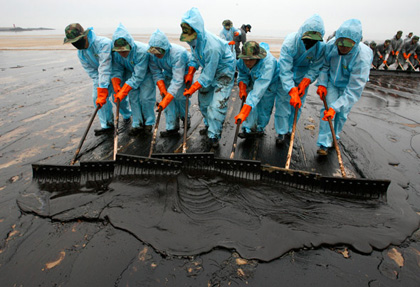 Oil spill beach clean up.
From newswire: The threat is here and is real.
COVINGTON, La. – The Gulf oil spill has surpassed the Exxon Valdez as the worst in U.S. history, according to new estimates released Thursday, but the Coast Guard and BP said an untested procedure to stop it seemed to be working.
A team of scientists trying to determine how much oil has been flowing since the offshore rig Deepwater Horizon exploded April 20 and sank two days later found the rate was more than twice and possibly up to five times as high as previously thought.
Even using the most conservative estimate, that means the leak has grown to nearly 19 million gallons over the past five weeks, surpassing the size of the 1989 Exxon Valdez disaster in Alaska, which at about 11 million gallons had been the nation's worst spill. Under the highest Gulf spill estimate, nearly 39 million gallons may have leaked, enough to fill 30 school gymnasiums.
"Now we know the true scale of the monster we are fighting in the Gulf," said Jeremy Symons, vice president of the National Wildlife Federation. "BP has unleashed an unstoppable force of appalling proportions."
BP did not immediately comment on the new estimate.

U.S. Geological Survey Director Marcia McNutt said two different teams of scientists calculated that the well has been spewing between 504,000 and more than a million gallons a day.
BP and the Coast Guard estimated soon after the explosion that about 210,000 gallons a day was leaking, but scientists who watched underwater video of well had been saying for weeks it was probably more.
Last week, BP inserted a mile-long tube to siphon some of the oil into a tanker. The tube sucked up 924,000 gallons, but engineers had to dismantle it so they could start the risky procedure known as a top kill to try to cut off the flow altogether by shooting heavy drilling fluid into the well.
If that works, BP will inject cement into the well to seal it. The top kill has been used above ground but has never been tried 5,000 feet beneath the sea. BP pegged its chance of success at 60 to 70 percent.
Lt. Commander Tony Russell, an aide to Coast Guard Adm. Thad Allen, said Thursday that the mud was stopping some oil and gas but had a ways to go before it proved successful. The top kill started Wednesday night and it could be several days before officials know if it is working.
"As you inject your mud into it, it is going to stop some hydrocarbons," Russell said. "That doesn't mean it's successful." BP spokesman Tom Mueller also discounted news reports that the top kill had worked.
"We appreciate the optimism, but the top kill operation is continuing through the day today — that hasn't changed," he said Thursday morning. "We don't anticipate being able to say anything definitive on that until later today."
Oil is coating birds and delicate wetlands along the Louisiana coast, and the political fallout from the spill has reached all the way to Washington, where the head of the federal agency that oversees offshore drilling resigned Thursday. Minerals Management Service Director Elizabeth Birnbaum stepped down just hours before a planned White House press conference where President Barack Obama was expected to extend a moratorium on new deepwater oil drilling.
Birnbaum and her agency came under withering criticism from lawmakers of both parties over lax oversight of drilling and cozy ties with industry. An internal Interior Department report released earlier this week found that between 2000 and 2008, agency staff members accepted tickets to sports events, lunches and other gifts from oil and gas companies and used government computers to view pornography. Birnbaum had run the service since July 2009.
After receiving the results of a 30-day safety review from Interior Secretary Ken Salazar, Obama also planned to delay controversial lease sales off the coast of Alaska and cancel entirely plans for drilling lease sales in the Western Gulf and off the coast of Virginia, according to a White House aide.
Polls show the public is souring on the administration's handling of the catastrophe, and fishermen, hotel and restaurant owners, politicians and residents along the 100-mile stretch of Gulf coast affected by the spill are fed up with BP's failures to stop the oil.
"I have anxiety attacks," said Sarah Rigaud, owner of Sarah's Restaurant in Grand Isle, La., where the public beach was closed because blobs of oil that looked like melted chocolate had washed up on shore. "Every day I pray that something happens, that it will be stopped and everybody can get back to normal."
The Coast Guard pulled commercial fishing boats from oil cleanup efforts in Breton Sound off the Louisiana coast on Wednesday after several people became ill. Crew members on three vessels reported nausea, dizziness, headaches and chest pains, the Coast Guard said. Four people were hospitalized, including one who was flown to a hospital.
If the top kill fails, BP says it has several backup plans, including sealing the well's blowout preventer with a smaller cap, which would contain the oil. An earlier attempt to cap the blowout preventer failed. BP could also try a "junk shot" — shooting golf balls and other debris into the blowout preventer to clog it up — during the top kill process.
The only permanent solution is drilling a second well, but that will take a couple of months. BP plans to go ahead with that even if the top kill works.
Though the spill is now the biggest in U.S. history, it's not the biggest ever in the Gulf. An offshore drilling rig in Mexican waters — the Ixtoc I — blew up in June 1979, releasing 140 million gallons of oil.
Oil rig spill, pictures tell it all. Enviroment-Animals
It’s been more than a month since an explosion on the Deepwater Horizon oil rig killed 11 people and blew out an undersea well that continues to gush oil into the Gulf of Mexico. In the following weeks, there have been attempts to contain and control the scope of the environmental damage.
But so far none have been successful. Over the weekend, Louisiana Gov. Bobby Jindal announced he intended to proceed with plans to construct sand booms to protect his state's shoreline — without waiting for federal approval. Meanwhile, engineers for BP are working feverishly to prepare for their "top kill" maneuver, hoping an injection of heavy mud will stop the leak.
Dead sharks and dolphins are washing ashore. Crabs, turtles and birds are being found soaked in oil as the slick sloshes into Louisiana’s wetlands. South of New Orleans, chocolate-like globs of oil have shut down the public beach.
Coast Guard officials say the spill’s impact now stretches 150 miles. Some scientists fear the spreading plumes will catch the ocean current to the Florida Keys and up to the eastern seaboard.
NOW...Biofuel is more convinient that man has all the controls on hand. Well, how careful and trustworthy is a robotic arm deep in the murky blue?, see how things can go wrong to such lenght.
Photographers' images, some of them chillingly beautiful, can only begin to hint at the enormity of the disaster. When we go deeper into sea to save the world in search of fuel, we CAN destroy the world in hours.


But so far none have been successful. Over the weekend, Louisiana Gov. Bobby Jindal announced he intended to proceed with plans to construct sand booms to protect his state's shoreline — without waiting for federal approval. Meanwhile, engineers for BP are working feverishly to prepare for their "top kill" maneuver, hoping an injection of heavy mud will stop the leak.
Dead sharks and dolphins are washing ashore. Crabs, turtles and birds are being found soaked in oil as the slick sloshes into Louisiana’s wetlands. South of New Orleans, chocolate-like globs of oil have shut down the public beach.
Coast Guard officials say the spill’s impact now stretches 150 miles. Some scientists fear the spreading plumes will catch the ocean current to the Florida Keys and up to the eastern seaboard.
NOW...Biofuel is more convinient that man has all the controls on hand. Well, how careful and trustworthy is a robotic arm deep in the murky blue?, see how things can go wrong to such lenght.
Photographers' images, some of them chillingly beautiful, can only begin to hint at the enormity of the disaster. When we go deeper into sea to save the world in search of fuel, we CAN destroy the world in hours.





Subscribe to:
Posts (Atom)