Last week, BP committed $500 million in a ten-year year research program to study "the impact of the Deepwater Horizon incident, and its associated response, on the marine and shoreline environment of the Gulf of Mexico." It recalls the $500 million BP invested in 2007 in the Energy Bioscienes Institute. Deepwater indeed for the oil industry this year - but if there are deep troubles, there are deep pockets.
Pockets are a little smaller around the biofuels industry, where this past week in Washington, four of the companies which have received investment support from oil majors or have formed investment partnerships with them - Coskata (Total), HR Biopetroleum (Shell), Solazyme (Chevron), Algenol (Valero), visited with reporters to discuss "the industry's #1 ask" this political season: the need for sustained and diverse tax credits.
Their goal, to develop "parity with solar and wind" in a tax credit design that unleashed billions in investment for other renewables from private equity.
But - private equity, schmequity. The $500 million committed by BP this week to studying the impact of Deepwater Horizon would have funded virtually any first-in-kind advanced biofuels project currently stalled for lack of finance, many of them already receiving investment from the oil industry and seeking, through "#1 asks" like HR 5412, to deploy their technologies at scale.
In the wake of the massive Gulf of Mexico oil spill, it’s clear the U.S. needs to end its crude-oil addiction as much to protect its economy as the environment.
To move the future forward, America needs one company in particular to come through on behalf of all Americans. In a cruel twist of fate, that company is ExxonMobil (XOM), which is working on arguably the most important energy-research project in the world today. Namely, a project to replace crude with genetically-modified algae that can be cost-effectively refined using existing refinery equipment.
A year ago when Exxon announced its algae project with biotech pioneer J. Craig Venter, the company said that it would take at least 5-10 years to produce commercial quantities of algae-based fuels. “My suspicion, and it’s just a suspicion, is that they still see it as five to 10 years away,” says Addison Wiggin, editorial director of The Daily Reckoning, who has been looking into the Exxon-Venter project for a forthcoming documentary on entrepreneurs in the post-crisis financial world.
Too long. As video of the black death pouring out of that ruptured pipeline gushes onto every American TV and computer screen, it's time for President Obama to declare a new Manhattan Project, a new man-to-moon space race. The goal must be to take America off its crude addiction in less than five years with a literally home-grown industry that will create tens of thousands of agricultural and other jobs without jeopardizing the existing oil industry’s trillion-dollar infrastructure.
Exxon shares would surge the moment this plan became publicly known; however, the President can’t allow the investor payoff to be too bountiful. There will have to be safeguards against Exxon controlling the applicable patents in order to prevent the company from controlling America’s energy future.
Algae oil is no panacea, the President will further need to say. Accelerated development of plug-in electric and all-electric vehicles is needed in order for the U.S. to have, by 2020 or sooner, a nationally-secure, environmentally-sound transportation infrastructure.
In a second twist of fate, not only would Exxon shares likely surge in price, so too might the shares of utilities that generate a lot of electricity from coal. Companies such as Duke Energy (DUK), Southern (SO) and FirstEnergy (FE) might lose their pariah image if part of the President’s strategy were to capture coal plants’ carbon dioxide and use it to accelerate algae growth.
For risk-inclined investors who believe that all this may be on the way, a company that might be worth a closer look right now is tiny OriginOil. (OOIL.OB). The company has started signing up customers as it begins commercializing a technology for producing biofuel from algae using CO2 emissions captured from smokestacks.
International news:
In Canada, the Canadian Renewable Fuels Association released a report on the Total Economic Impact Assessment of Biofuels Plants in Canada, which found that the construction of 28 renewable fuels plants in Canada generated $2.949 billion in economic activity. The construction activity created 14,177 direct and indirect jobs during the respective construction periods.
In Australia, Mission NewEnergy Limited (ASX: MBT) announced that the commissioning of its second 75 Mgy Axens 2nd Generation biodiesel trans-esterification refinery has been completed. Mission expects to begin producing under its Valero contract once the U.S. Environmental Protection Agency has accepted palm oil as an approved pathway, and makes palm oil biodiesel eligible for Renewable Identification Number (RINS).
In Barbados, Amelot Holdings and Barbados National Oil Company have signed an MOU for the ownership and operation of a biodiesel production facility, using waste cooking oil as a feedstock. BNOCL also plans to develop B20 pumps for biodiesle distribution. The facility will use containerized modular equipment and proprietary feedstock technology.
Tuesday, June 1, 2010


Thursday, May 27, 2010
Offshore Oil Disaster Could Boost New-Age Biofuels

Gulf of Mexico oil spill has dimmed the prospects for new offshore oil drilling, next-generation biofuels may be able to compensate for that lost production, marking the start of a bigger move away from oil.
Crisis in the Gulf
"Six-billion dollars goes a long way,” says one energy fund portfolio manager, referring to one estimate of the oil spill’s final cost. “With the right amount of investment [in biofuels], eventually the need for new [fossil fuel] production drops at some point. Is it $6 billion? I don’t know.”
Biofuels like ethanol and biodiesel have been commercially available for some time, mandated by various laws and regulations, but are usually blended with their fossil-fuel-derived counterparts.
Next-generation biofuels in the development pipeline now use different processes to create fuels from renewable feedstocks—animal fats and algae for example—that are chemically identical to the products created from petroleum.
Known as “drop-in fuels", they can be put directly into gas tanks and burned like fossil-fuel gasoline and diesel, with no equipment modifications or blending needed.
“There’s no need to rebuild the entire infrastructure” says Advanced BioFuels Association president Michael McAdams, a trade organization representing biofuels developers. “It could be $20 billion to retrofit the market for (more) corn-based ethanol.”
Several members of McAdams’ organization are now ramping up test-production facilities.
Biofuel generation at a Tyson Foods [TSN 17.65 0.92 (+5.5%) ] processing plant in Louisiana will come online later this year, turning chicken fat into diesel with a production capacity of 75 million gallons a year.
Tyson produces about 300 million gallons of chicken fat per year, and would normally sell it for use in other chemical processes or simply pay for disposal.
Finland's Neste Oil is now producing 700 million gallons of diesel from green feedstocks in several different countries.
McAdams notes Neste’s output is the equivalent to that of the entire US biodiesel sector at the moment but the green-fuels sector will need greater scale quickly to replace any new capacity from offshore oil.
Oil firms operating in the Gulf of Mexico produce about 71.5 million gallons of crude daily, and convert some of that oil to about 3 million gallons of diesel daily, according to DOE figures. Offshore oil production currently provides about 8 percent of daily US oil consumption.
Photo by Fred LaSenna
Though the output gap between the two fuels is now enormous, proponents say the seven-to-ten year development window from permits to production for new offshore drilling projects, allows ample time to ramp up production and approach parity.
George Santana, director of research at independent research and banking firm Greener Dawn, says that commercial production of next-generation biofuels is now achievable in that time frame.
He points out that perfecting the enzymes needed for cellulosic ethanol production is probably three to five years away from commercialization, while algae-derived drop-in fuels are five to ten years away.
McAdams agrees that drop-in biofuels are still in the demonstration plant phase, but as firms like Neste and Tyson demonstrate feasibility, investment should flow and scale could be achieved quickly.
“Ethanol took 20 years to achieve commercial scale,” McAdamas points out. “But then took six years to double production.”
John Felmy, API’s chief economist, says take those estimates with a grain of salt. “In the early 80s, people were saying cellulosic ethanol was five years away.”
But the cost gap is closing from both ends, and investment in biofuels today hinges on the rising cost of oil production and on tax incentives to help bridge the remaining difference.
For oil production costs, Felmy points to a 2008 Department of Energy survey placing US offshore production costs at $73/barrel, versus $38/barrel in Canada and $17/barrel in the Middle East.
Joule Biotechnologies, a green energy startup making diesel fuel from algae-like organisms, is aiming for production costs of as little as $30 per barrel.
Cost of production comparisons aren’t the only point of contention between green and fossil fuel energy firms.
As a large employers and sources of tax revenues—often in areas of high unemployment—all energy producers sell themselves as job creators, and all benefit from government subsidies in the process.
McAdams and Felmy disagree over which sector has benefited the most from government tax incentives in recent years, but a 2007 report on oil and gas sector subsidies from the Congressional Research Service, a non-partisan group that provides data and analysis to members of Congress, showed tax credits were evenly distributed.
The Carbon Challenge - A CNBC Special Report - See Complete Coverage
The agency determined that over an eleven-year period, oil and gas exploration/distribution tax credits were $5.6 billion, versus $5.7 billion for all renewable energy and energy efficiency initiatives.
Gauging job growth in the nascent biofuels sector is tough at this point, but industry sources claim it requires similar headcount, in production and distribution at least, to the oil and gas sector.
Felmy adds that even if new biofuel production replaces proposed expansion in US offshore drilling down the road, the US will still be consuming oil at that point.
“To the extent we're going to need [oil] and we're going to need it for the foreseeable future, we may as well produce it here, " he says.
DOE and industry sources, however, estimate that any new offshore capacity would meet growth in our domestic oil demand for a period of less than three years, based on projected consumption trends.
Greener Dawn’s Santana says that supports the case for moving investment capital into greener fuels now, when the price of oil is well off its sky-high peak of two years ago.
“Biofuels are not going to drive oil costs down to zero anytime soon,” he says, adding that we’ll be still consuming oil even if biofuels can replace any new offshore oil production. “But it can bend the [cost] curve.”
Gulf oil spill now bigger than Exxon Valdez
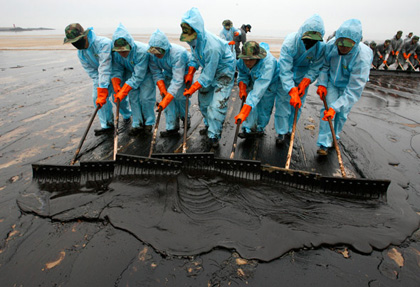 Oil spill beach clean up.
From newswire: The threat is here and is real.
COVINGTON, La. – The Gulf oil spill has surpassed the Exxon Valdez as the worst in U.S. history, according to new estimates released Thursday, but the Coast Guard and BP said an untested procedure to stop it seemed to be working.
A team of scientists trying to determine how much oil has been flowing since the offshore rig Deepwater Horizon exploded April 20 and sank two days later found the rate was more than twice and possibly up to five times as high as previously thought.
Even using the most conservative estimate, that means the leak has grown to nearly 19 million gallons over the past five weeks, surpassing the size of the 1989 Exxon Valdez disaster in Alaska, which at about 11 million gallons had been the nation's worst spill. Under the highest Gulf spill estimate, nearly 39 million gallons may have leaked, enough to fill 30 school gymnasiums.
"Now we know the true scale of the monster we are fighting in the Gulf," said Jeremy Symons, vice president of the National Wildlife Federation. "BP has unleashed an unstoppable force of appalling proportions."
BP did not immediately comment on the new estimate.

U.S. Geological Survey Director Marcia McNutt said two different teams of scientists calculated that the well has been spewing between 504,000 and more than a million gallons a day.
BP and the Coast Guard estimated soon after the explosion that about 210,000 gallons a day was leaking, but scientists who watched underwater video of well had been saying for weeks it was probably more.
Last week, BP inserted a mile-long tube to siphon some of the oil into a tanker. The tube sucked up 924,000 gallons, but engineers had to dismantle it so they could start the risky procedure known as a top kill to try to cut off the flow altogether by shooting heavy drilling fluid into the well.
If that works, BP will inject cement into the well to seal it. The top kill has been used above ground but has never been tried 5,000 feet beneath the sea. BP pegged its chance of success at 60 to 70 percent.
Lt. Commander Tony Russell, an aide to Coast Guard Adm. Thad Allen, said Thursday that the mud was stopping some oil and gas but had a ways to go before it proved successful. The top kill started Wednesday night and it could be several days before officials know if it is working.
"As you inject your mud into it, it is going to stop some hydrocarbons," Russell said. "That doesn't mean it's successful." BP spokesman Tom Mueller also discounted news reports that the top kill had worked.
"We appreciate the optimism, but the top kill operation is continuing through the day today — that hasn't changed," he said Thursday morning. "We don't anticipate being able to say anything definitive on that until later today."
Oil is coating birds and delicate wetlands along the Louisiana coast, and the political fallout from the spill has reached all the way to Washington, where the head of the federal agency that oversees offshore drilling resigned Thursday. Minerals Management Service Director Elizabeth Birnbaum stepped down just hours before a planned White House press conference where President Barack Obama was expected to extend a moratorium on new deepwater oil drilling.
Birnbaum and her agency came under withering criticism from lawmakers of both parties over lax oversight of drilling and cozy ties with industry. An internal Interior Department report released earlier this week found that between 2000 and 2008, agency staff members accepted tickets to sports events, lunches and other gifts from oil and gas companies and used government computers to view pornography. Birnbaum had run the service since July 2009.
After receiving the results of a 30-day safety review from Interior Secretary Ken Salazar, Obama also planned to delay controversial lease sales off the coast of Alaska and cancel entirely plans for drilling lease sales in the Western Gulf and off the coast of Virginia, according to a White House aide.
Polls show the public is souring on the administration's handling of the catastrophe, and fishermen, hotel and restaurant owners, politicians and residents along the 100-mile stretch of Gulf coast affected by the spill are fed up with BP's failures to stop the oil.
"I have anxiety attacks," said Sarah Rigaud, owner of Sarah's Restaurant in Grand Isle, La., where the public beach was closed because blobs of oil that looked like melted chocolate had washed up on shore. "Every day I pray that something happens, that it will be stopped and everybody can get back to normal."
The Coast Guard pulled commercial fishing boats from oil cleanup efforts in Breton Sound off the Louisiana coast on Wednesday after several people became ill. Crew members on three vessels reported nausea, dizziness, headaches and chest pains, the Coast Guard said. Four people were hospitalized, including one who was flown to a hospital.
If the top kill fails, BP says it has several backup plans, including sealing the well's blowout preventer with a smaller cap, which would contain the oil. An earlier attempt to cap the blowout preventer failed. BP could also try a "junk shot" — shooting golf balls and other debris into the blowout preventer to clog it up — during the top kill process.
The only permanent solution is drilling a second well, but that will take a couple of months. BP plans to go ahead with that even if the top kill works.
Though the spill is now the biggest in U.S. history, it's not the biggest ever in the Gulf. An offshore drilling rig in Mexican waters — the Ixtoc I — blew up in June 1979, releasing 140 million gallons of oil.
Oil rig spill, pictures tell it all. Enviroment-Animals
It’s been more than a month since an explosion on the Deepwater Horizon oil rig killed 11 people and blew out an undersea well that continues to gush oil into the Gulf of Mexico. In the following weeks, there have been attempts to contain and control the scope of the environmental damage.
But so far none have been successful. Over the weekend, Louisiana Gov. Bobby Jindal announced he intended to proceed with plans to construct sand booms to protect his state's shoreline — without waiting for federal approval. Meanwhile, engineers for BP are working feverishly to prepare for their "top kill" maneuver, hoping an injection of heavy mud will stop the leak.
Dead sharks and dolphins are washing ashore. Crabs, turtles and birds are being found soaked in oil as the slick sloshes into Louisiana’s wetlands. South of New Orleans, chocolate-like globs of oil have shut down the public beach.
Coast Guard officials say the spill’s impact now stretches 150 miles. Some scientists fear the spreading plumes will catch the ocean current to the Florida Keys and up to the eastern seaboard.
NOW...Biofuel is more convinient that man has all the controls on hand. Well, how careful and trustworthy is a robotic arm deep in the murky blue?, see how things can go wrong to such lenght.
Photographers' images, some of them chillingly beautiful, can only begin to hint at the enormity of the disaster. When we go deeper into sea to save the world in search of fuel, we CAN destroy the world in hours.


But so far none have been successful. Over the weekend, Louisiana Gov. Bobby Jindal announced he intended to proceed with plans to construct sand booms to protect his state's shoreline — without waiting for federal approval. Meanwhile, engineers for BP are working feverishly to prepare for their "top kill" maneuver, hoping an injection of heavy mud will stop the leak.
Dead sharks and dolphins are washing ashore. Crabs, turtles and birds are being found soaked in oil as the slick sloshes into Louisiana’s wetlands. South of New Orleans, chocolate-like globs of oil have shut down the public beach.
Coast Guard officials say the spill’s impact now stretches 150 miles. Some scientists fear the spreading plumes will catch the ocean current to the Florida Keys and up to the eastern seaboard.
NOW...Biofuel is more convinient that man has all the controls on hand. Well, how careful and trustworthy is a robotic arm deep in the murky blue?, see how things can go wrong to such lenght.
Photographers' images, some of them chillingly beautiful, can only begin to hint at the enormity of the disaster. When we go deeper into sea to save the world in search of fuel, we CAN destroy the world in hours.





Tuesday, May 25, 2010
Scientist Attack Biofuel!
There were 90 respected scientist who seem to come seeking any arguable biofuel development loopholes as also being a contributor and needing to 'slack off' policy in USA on biofuels. The biofuel worldwide has eyes on this:
Here is what they say and what we say respectively, readers and audience can judge. The issue is 'backed' seem to me personally by big cats if possible (who knows?).
Here is what they wrote to the speaker Nancy Pelosi:
May 17, 2010
The Honorable Nancy Pelosi
Speaker
U.S. House of Representatives
235 Cannon House Office Building
Washington, DC 20515-0508
Fax: (202)225-4188
The Honorable Harry Reid
Majority Leader
United States Senate
522 Hart Senate Office Building
Washington, DC 20510-2803
Fax: (202) 224-7327
Dear Speaker Pelosi and Majority Leader Senator Reid,
We write to bring to your attention the importance of accurately accounting for carbon dioxide emissions from bioenergy in any law or regulation designed to reduce greenhouse gas emissions from energy use. Proper accounting can enable bioenergy to contribute to greenhouse gas reductions; improper accounting can lead to increases in greenhouse gas emissions both domestically and internationally.
Replacement of fossil fuels with bioenergy does not directly stop carbon dioxide emissions from tailpipes or smokestacks. Although fossil fuel emissions are reduced or eliminated, the combustion of biomass replaces fossil emissions with its own emissions (which may even be higher per unit of energy because of the lower energy to carbon ratio of biomass). Bioenergy can reduce atmospheric carbon dioxide if land and plants are managed to take up additional carbon dioxide beyond what they would absorb without bioenergy. Alternatively, bioenergy can use some vegetative residues that would otherwise decompose and release carbon to the atmosphere rapidly. Whether land and plants sequester additional carbon to offset emissions from burning the biomass depends on changes both in the rates of plant growth and in the carbon storage in plants and soils. For example, planting fast-growing energy crops on otherwise unproductive land leads to additional carbon absorption by plants that offsets emissions from their use for energy without displacing carbon storage in plants and soils. On the other hand, clearing or cutting forests for energy, either to burn trees directly in power plants or to replace forests with bioenergy crops, has the net effect of releasing otherwise sequestered carbon into the atmosphere, just like the extraction and burning of fossil fuels. That creates a carbon debt, may reduce ongoing carbon uptake by the forest, and as a result may increase net greenhouse gas emissions for an extended time period and thereby undercut greenhouse gas reductions needed over the next several decades1
Many international treaties and domestic laws and bills account for bioenergy incorrectly by treating all bioenergy as causing a 100% reduction in emissions regardless of the source of the biomass. They perpetuate this error by exempting carbon dioxide from bioenergy from national emissions limits or from domestic requirements to hold allowances for energy emissions. Most renewable energy standards for electric utilities have the same effect because bioenergy is viewed as a renewable energy even when the biomass does not eliminate or even reduce greenhouse gas emissions. This general approach .
1 J. Fargione, J. Hill, Tilman D., Polasky S., Hawthorne P (2008), Land Clearing and the Biofuel Carbon Debt, Science 319:1235-1238
appears to be based on a misunderstanding of IPCC guidance2
U.S. laws will also influence world treatment of bioenergy. A number of studies in distinguished journals have estimated that globally improper accounting of bioenergy could lead to large-scale clearing of the world’s forests. Under some scenarios, this approach could eliminate most of the expected greenhouse gas reductions during the next several decades.
3
The lesson is that any legal measure to reduce greenhouse gas emissions must include a system to differentiate emissions from bioenergy based on the source of the biomass. The National Academy of Sciences has estimated significant potential energy production from the right sources of biomass.
4
Sincerely, . Proper accounting will provide incentives for these sources of bioenergy.
2 T.D. Searchinger, S.P. Hamburg, J.Melillo, W. Chameides, P.Havlik, D.M. Kammen, G.E. Likens, R. N. Lubowski, M. Obersteiner, M. Oppenheimer, G. P. Robertson, W.H. Schlesinger, G.D. Tilman (2009), Fixing a Critical Climate Accounting Error, Science 326:527-528
3 E.g., J.M. Mellillo, J.M. Reilly, D.W. Kicklighter, A.C. Gurgel, T.W. Cronin, S. Patsev, B.S. Felzer, X. Wang, C.A. Schlosser (2009), Indirect Emissions from Biofuels: How Important?, Science 326:1397-1399; Marshall Wise, Katherine Calvin, Allison Thomson, Leon Clarke, Benjamin Bond-Lamberty, Ronald Sands, Steven J. Smith, Anthony Janetos, James Edmonds (2009), Implications of Limiting CO2 Concentrations for Land Use and Energy, Science 324:1183-1186
4 National Research Council (2009), Liquid Transportation Fuels from Coal and Biomass: Technological Status, Costs, and Environmental Impacts (National Academy of Sciences, Washington, D.C.)
William H. Schlesinger (Member, National Academy of Sciences)
President
(Past President, Ecological Society of America)
Cary Institute of Ecosystem Studies
Millbrook, New York
Michael Allen
Director of the Center for Conservation Biology
Chair of the Department of Plant Pathology and Microbiology
University of California, Riverside
Riverside, California
Viney P. Aneja
Professor Air Quality
Professor Environmental Technology
Department of Marine, Earth, and Atmospheric Sciences
North Carolina State University
Raleigh, North Carolina
Gary W. Barrett
Eugene P. Odum Chair of Ecology
Odum School of Ecology
University of Georgia
Athens, Georgia
Mark Battle
Associate Professor
Physics & Astronomy
Bowdoin College
Brunswick, Maine
Sharon Billings
Associate Professor
Department of Ecology and Evolutionary Biology
Kansas Biological Survey
Lawrence, Kansas
Mark A. Bradford Assistant Professor of Terrestrial Ecosystem Ecology Yale School of Forestry and Environmental Studies
Yale University
Donald Kennedy
(Member, National Academy of Sciences)
Bing Professor Environmental Science and Policy
President, Emeritus
Stanford University
Stanford, California
New Haven, Connecticut
Phil Camill
Rusack Associate Professor of Environmental Studies
Earth and Oceanographic Science Director,
Environmental Studies
Bowdoin College
Brunswick, Maine
Elliott Campbell
Assistant Professor School of Engineering & Sierra Nevada Research Institute
University of California, Merced
Merced, California
Joseph Craine
Assistant Professor
Division of Biology
Kansas State University
Manhattan, Kansas
Stephen R. Carpenter
(Member, U.S. National Academy of Sciences)
Director and Professor
(Past President, Ecological Society of America)
Center for Limnology
University of Wisconsin
Madison, Wisconsin
Sallie (Penny) Chisholm
(Member, National Academy of Sciences) Martin Professor of Environmental Studies
Massachusetts Institute of Technology
Cambridge, Massachusetts
Eric Chivian
(Shared 1985, Nobel Peace Prize) Director Center for Health and the Global Environment Harvard Medical School Cambridge, Massachusetts
Norm Christensen
(Past President, Ecological Society America)
Professor of Ecology
Nicholas School of the Environment
Duke University
Durham, North Carolina
James S. Clark
Hugo Blomquist Professor
Nicholas School of the Environment/Dept Biology
Duke University
Durham, North Carolina
Jon Cole
Distinguished Senior Scientist and G.E. Hutchinson Chair
Cary Institute of Ecosystem Studies
Millbrook, New York.
Gretchen C. Daily
(Member, National Academy of Sciences) Stanford University Stanford, California
Frank P. Day
Professor of Biological Sciences and Eminent Scholar
Old Dominion University
Norfolk, Virginia
Seth DeBolt
Assistant Professor
Horticulture Department
University of Kentucky
Lexington, Kentucky
Evan H. DeLucia
G. William Arends Professor of Integrative Biology & Director,
School of Integrative Biology
University of Illinois
Urbana, Illinois
Samir Doshi
Gund Institute for Ecological Economics
University of Vermont
Burlington, Vermont
Dr. Charles T. Driscoll
(Member, National Academy of Engineering)
University Professor
Department of Civil and Environmental Engineering
Syracuse University
Syracuse, New York
Paul R. Ehrlich
(Member, National Academy of Sciences)
Bing Professor of Biology and
President, Center for Conservation Biology
Stanford University,
Stanford, California
James Ehleringer
Distinguished Professor of Biology
Director, Global Change and Ecosystem Center
University of Utah
Salt Lake City, Utah
Erle C. Ellis
Associate Professor
Department of Geography & Environmental Systems
University of Maryland, Baltimore County
Baltimore, Maryland
Paul R. Epstein, M.D. Associate Director Center for Health and the Global Environment Harvard Medical School Boston, Massachusetts
Paul Falkowski
(Member of the National Academy of Sciences)
Board of Governors' Professor
Marine, Earth and Planetary Sciences
Rutgers University
New Brunswick, New Jersey
Adrien Finzi Associate Professor Department of Biology Boston University Boston, Massachusetts
Andrew J. Friedland
The Richard and Jane Pearl Professor in Environmental Studies
Chair, Environmental Studies Program
Dartmouth College
Hanover, New Hampshire
James N. Galloway
Department of Environmental Sciences
University of Virginia
Charlottesville, Virginia
Frank S. Gilliam Department of Biological Sciences Marshall University Huntington, West Virginia
Christine L. Goodale
Assistant Professor
Department of Ecology & Evolutionary Biology
Cornell University
Ithaca, New York
Nancy B. Grimm
(Past President, Ecological Society America) Professor,
Department of Biology
Arizona State University
Phoenix, Arizona
Peter M. Groffman
Senior Scientist
Cary Institute of Ecosystem Studies
Millbrook, New York
Nick M. Haddad
Associate Professor
Department of Biology
North Carolina State University
Raleigh, North Carolina
Charles A.S. Hall
College of Environmental Science and Forestry
State University of New York
Syracuse New York
John Harte
Professor of Ecosystem Sciences
Energy and Resources Group
University of California
Berkeley, California
Harold Hemond
W. E. Leonhard Professor of Civil and Environmental Engineering
Massachusetts Institute of Technology
Cambridge, Massachusetts
Sarah Hobbie
Associate Professor
Department of Ecology, Evolution, and Behavior
University of Minnesota
Minneapolis, Minnesota
Kirsten Hofmockel
Department of Ecology, Evolution, & Organismal Biology
Iowa State University
Ames, Iowa
R.A. Houghton
Deputy Director and Senior Scientist Woods Hole Research Center Falmouth, Massachusetts
Benjamin Houlton
Assistant Professor, Terrestrial Biogeochemistry
Department of Land, Air and Water Resources
University of California at Davis
Davis, California
Robert W. Howarth
David R. Atkinson Professor of Ecology and Environmental Biology
Cornell University
Ithaca, New York
A. Hope Jahren
Department of Geology & Geophysics
University of Hawaii
Honolulu, Hawaii
Dan Janzen
DiMaura Professor of Conservation Biology
University of Pennsylvania
Philadelphia, Pennsylvania
Daniel Kammen
Class of 1935 Distinguished Professor of Energy Professor in the Energy and Resources Group
and in the Goldman School of Public Policy
Director, Renewable and Appropriate Energy Laboratory University of California, Berkeley
Berkeley, California
William S. Keeton
Associate Professor
Center for Natural Resources
Rubenstein School of Environment and Natural Resources
University of Vermont
Burlington, Vermont
Thomas H. Kunz
Professor and Director
Center for Ecology and Conservation Biology
Department of Biology
Boston University
Boston, Massachusetts
Beverly Law
Professor, Global Change Forest Science
Department of Forest Ecosystems & Society
College of Forestry
Oregon State University
Corvallis, Oregon
John Lichter
Associate Professor
Department of Biology
Bowdoin College
Brunswick, Maine
Gene E. Likens
(Member, National Academy of Sciences)
Distinguished Senior Scientist
(Past President, Ecological Society America)
Founding President, Emeritus (Recipient, 2005, National Medal of Science)
Cary Institute of Ecosystem Studies
Millbrook, New York
Thomas Lovejoy
Heinz Center Biodiversity Chair
Heinz Center for Environment
Washington, D.C.
Daniel Markewitz Associate Professor Warnell School of Forestry and Natural Resources University of Georgia Athens, Georgia
Roz Naylor
Professor, Environmental Earth Science;
William Wrigley Senior Fellow, and
Director, Program on Food Security and the Environment
Stanford University
Stanford, California
Jason Neff
Associate Professor
Geological Sciences and Environmental Studies
University of Colorado at Boulder
Boulder, Colorado
Michael O’Hare
Professor of Public Policy
Goldman School of Public Policy
University of California at Berkeley
Berkeley, California
Scott Ollinger Associate Professor of Natural Resources Complex Systems Research Center Institute for the Study of Earth, Oceans and Space University of New Hampshire Durham, New Hampshire
Michael Oppenheimer
Albert G. Milbank Professor of Geosciences and International Affairs
Woodrow Wilson School
Princeton University
Princeton, New Jersey
Margaret A. Palmer
Professor and Director
Chesapeake Biological Lab
University of Maryland
College Park, Maryland
Todd Palmer
Department of Biology
University of Florida
Gainesville, Florida
Richard P. Phillips
Assistant Professor
Department of Biology
Indiana University
Bloomington, Indiana
Stuart Pimm
Doris Duke Professor of Conservation Ecology
Nicholas School of the Environment
Duke University
Durham, North Carolina
Jennifer S. Powers
Assistant Professor
Department of Ecology, Evolution & Behavior
University of Minnesota
Minneapolis, Minnesota
James W. Raich
Professor
Department of Ecology, Evolution & Organismal Biology
Iowa State University
Ames, Iowa
Chantal D Reid
Assistant Professor of the Practice
Department of Biology and
Nicholas School of the Environment
Duke University
Durham, North Carolina
William A. Reiners
Professor of Botany and
J.E. Warren Professor of Energy and Environment
University of Wyoming
Laramie, Wyoming
Heather Reynolds
Associate Professor
Department of Biology
Indiana University
Bloomington Indiana
G. Philip Robertson University Distinguished Professor W.K. Kellogg Biological Station and Department of Crop and Soil Sciences Michigan State University Hickory Corners, Michigan
Steve Running
Regents Professor and Director,
Numerical Terradynamic Simulation Group
Department of Ecosystem Sciences
University of Montana
Missoula, Montana
Lee Schipper
Project Scientist
Global Metropolitan Studies
UC Berkeley
And Senior Research Engineer
Precourt Energy Efficiency Center
Stanford University
Stephen H. Schneider (Member, National Academy of Sciences) Melvin and Joan Lane Professor for
Interdisciplinary Environmental Studies, Professor, Department of Biology and Senior Fellow, Woods Institute for the Environment
Stanford University
Stanford, California
H.H. Shugart
W.W. Corcoran Professor
Department of Environmental Sciences
University of Virginia
Charlottesville, Virginia
Kirk R. Smith (Member, National Academy of Sciences)
Professor of Global Environmental Health
Director, Global Health and Environment Program
School of Public Health
University of California
Berkeley, California
Stanley D. Smith Associate Vice President for Research Professor of Life Sciences University of Nevada Las Vegas, Nevada
Robert Socolow
Department of Mechanical and Aerospace Engineering
Director of the Carbon Mitigation Initiative
Princeton University
Princeton, New Jersey
John Sperry
Professor
Biology Department
University of Utah
Salt Lake City, Utah
Dan Sperling
Professor and Director
Institute of Transportation Studies
University of California
Davis, California
Jennifer L. Tank
Galla Associate Professor of Ecology
Department of Biological Sciences
University of Notre Dame
Notre Dame, Indiana
Pamela Templer
Assistant Professor
Boston University
Boston, Massachusetts
John Terborgh
(Member, National Academy of Sciences)
Nicholas School of the Environment
Duke University
Durham, North Carolina
Thomas P. Tomich
W.K. Kellogg Endowed Chair in Sustainable Food Systems
Director, UC Davis Agricultural Sustainability Institute
Director, UC Sustainable Agriculture Research and Education Program
Professor of Community Development, Environmental Science & Policy
University of California
Davis, California
Alan R. Townsend
Professor, Institute of Arctic and Alpine Research and
Department of Ecology and Evolutionary Biology
Director, Environmental Studies Program
University of Colorado
Boulder, Colorado
Ross A. Virginia
Myers Family Professor of Environmental Science
Director, Institute of Arctic Studies
Dartmouth College
Hanover, New Hampshire
Diana H. Wall
(Past President, Ecological Society of America)
University Distinguished Professor
Director, School of Global Environmental Sustainability
Colorado State University
Fort Collins, Colorado
Matthew Wallenstein
Research Scientist Natural Resource Ecology Laboratory Colorado State University Fort Collins, Colorado
Thomas R. Wentworth
Alumni Distinguished Undergraduate Professor of Plant Biology
North Carolina State University
Raleigh, North Carolina
Donald R. Zak
Burton V. Barnes Collegiate Professor of Ecology
University of Michigan
Ann Arbor, Michigan
Cc: Carol Browner, White House Office of Energy and Climate Change Policy
Lisa Jackson, Environmental Protection Agency
Steven Chu, Ph.D, Department of Energy
John Holdren, Ph.D, President’s Council of Advisors on Science and Technology
Here is what we say: Biofuel/biofuel digest-worldwide.
Reaction from the Natural Resources Defense Council
Nathanael Greene, of the Natural Resources Defense Council, commented: “Today a group of leading scientists from across the country sent a letter to congressional leaders and Obama officials urging them to carefully count the carbon from biomass burned for energy as part of a comprehensive climate bill or any other legislation or regulation.
The American Power Act (APA) proposed by Senators Kerry and Lieberman provides a solid framework for reducing our global warming pollution and investing in a cleaner economy. Unfortunately, as proposed, the bill would turn a blind eye towards emissions from biomass combustion, threatening to significantly undermine the bills carbon reduction goals. (For some basic thoughts on how the bill should be amended see this fact sheet put out by NRDC and other groups after the House climate bill passed.)
I did a little video late last year explaining the fundamental flaw in the approach that the APA would take. The letter from the scientists puts it clearly: Replacement of fossil fuels with bioenergy does not directly stop carbon dioxide emissions from tailpipes or smokestacks. Although fossil fuel emissions are reduced or eliminated, the combustion of biomass replaces fossil emissions with its own emissions (which may even be higher per unit of energy because of the lower energy to carbon ratio of biomass). Bioenergy can reduce atmospheric carbon dioxide if land and plants are managed to take up additional carbon dioxide beyond what they would absorb without bioenergy…. On the other hand, clearing or cutting forests for energy, either to burn trees directly in power plants or to replace forests with bioenergy crops, has the net effect of releasing otherwise sequestered carbon into the atmosphere, just like the extraction and burning of fossil fuels. That creates a carbon debt, may reduce ongoing carbon uptake by the forest, and as a result may increase net greenhouse gas emissions for an extended time period and thereby undercut greenhouse gas reductions needed over the next several decades.
The Digest’s take: ”Round up the Usual Suspects.”
The letter was signed by seven members of the National Academy of Sciences and a Nobel Peace Prize co-laureate. and should be taken seriously as a point of view in science, and certainly as a political act.
This letter represents scientists, but does it represent science? Imagine what a country the United States would have turned out to be if every US state ratified a different Constitution.
It was primarily signed by biologists and ecologists and did not include leading scientists noted in the development of bioenergy technologies — such as George Church, Chris Somerville, Bruce Dale, Lee Lynd, or Charles Wyman to cite a few examples. A letter signed by a more inclusive group of scientists would have done more to dispel the sense that this letter represents a narrowly-held view within the scientific community, rather than consensus, and consensus must be the basis of any renewable energy policy which would provide any of the benefits of policy stability that renewables as a sector unequivocally require.
Give me Liberty or Give me Death: Give Us Unity or We’ll Face Dearth
The Digest urgently calls on its friends in the scientific community, through the National Academy of Sciences, or other appropriate vehicles, to develop a point of view which can be generally said to be representative of a broad scientific consensus. We have seen what a lack of consensus can do to side-track the discussion of climate change.
Whatever the consensus is, let the chips fall where they may.
Renewable energy needs stability, not a series of partisan letters from open side of the table that can be expected to be answered with a parallel set of letters from the other. That’s ping-pong, not policy, and the time for games has long since passed.
Here at Biofuel, we believe that we are capable to go green and in one big leap will support the world go green and efficiently support and supply the needed commodity The fuel...that is Biofuel for blend or pure! Beside we are cleaning the tons of trash laid down by 200 years of fossil fuel. A group of scientist from that corner of the world cannot ultimately turn down biofuel..we further emphasis that panel of scientists from all arena will have to give in their grip on Biofuel. Besides, Biofuel is a wheel that is at your disposal to steer the course unlike fossil fuel.
Responses
millercs | May 25, 2010 | Reply
I am amazed at the fossil thinking of these “scientists.”
1) There is a fundamental difference to the carbon content of the atmosphere between using fossil carbon and biogenic carbon sources. Fossil carbon combustion adds GHG that was never part of the carbon cycle before – carbon positive. Biogenic carbon combustion simply recycles that which is already in the atmosphere – carbon neutral.
2) GHG emissions is only one scientific reason for replacing fossil fuels with biogenic. Others include: fossil is not renewable (biogenic is); fossil distillation is getting more toxic (biogenic is getting cleaner); direct fossil land and water use change is severely impacting ecology (i.e., oilspills and tar sands); bioenergy conversion facilities will provide env. clean-up and funding for timberland thinnings, hurricane knockdown, flood demolition, invasive species control, landfill mitigation, etc.
This doesn’t even begin to cover the environment, pollution, and biodiversity costs of present and future strategic commodity resource wars like Iraq.Someone needs to rethink their carbon accounting.
Here is what they say and what we say respectively, readers and audience can judge. The issue is 'backed' seem to me personally by big cats if possible (who knows?).
Here is what they wrote to the speaker Nancy Pelosi:
May 17, 2010
The Honorable Nancy Pelosi
Speaker
U.S. House of Representatives
235 Cannon House Office Building
Washington, DC 20515-0508
Fax: (202)225-4188
The Honorable Harry Reid
Majority Leader
United States Senate
522 Hart Senate Office Building
Washington, DC 20510-2803
Fax: (202) 224-7327
Dear Speaker Pelosi and Majority Leader Senator Reid,
We write to bring to your attention the importance of accurately accounting for carbon dioxide emissions from bioenergy in any law or regulation designed to reduce greenhouse gas emissions from energy use. Proper accounting can enable bioenergy to contribute to greenhouse gas reductions; improper accounting can lead to increases in greenhouse gas emissions both domestically and internationally.
Replacement of fossil fuels with bioenergy does not directly stop carbon dioxide emissions from tailpipes or smokestacks. Although fossil fuel emissions are reduced or eliminated, the combustion of biomass replaces fossil emissions with its own emissions (which may even be higher per unit of energy because of the lower energy to carbon ratio of biomass). Bioenergy can reduce atmospheric carbon dioxide if land and plants are managed to take up additional carbon dioxide beyond what they would absorb without bioenergy. Alternatively, bioenergy can use some vegetative residues that would otherwise decompose and release carbon to the atmosphere rapidly. Whether land and plants sequester additional carbon to offset emissions from burning the biomass depends on changes both in the rates of plant growth and in the carbon storage in plants and soils. For example, planting fast-growing energy crops on otherwise unproductive land leads to additional carbon absorption by plants that offsets emissions from their use for energy without displacing carbon storage in plants and soils. On the other hand, clearing or cutting forests for energy, either to burn trees directly in power plants or to replace forests with bioenergy crops, has the net effect of releasing otherwise sequestered carbon into the atmosphere, just like the extraction and burning of fossil fuels. That creates a carbon debt, may reduce ongoing carbon uptake by the forest, and as a result may increase net greenhouse gas emissions for an extended time period and thereby undercut greenhouse gas reductions needed over the next several decades1
Many international treaties and domestic laws and bills account for bioenergy incorrectly by treating all bioenergy as causing a 100% reduction in emissions regardless of the source of the biomass. They perpetuate this error by exempting carbon dioxide from bioenergy from national emissions limits or from domestic requirements to hold allowances for energy emissions. Most renewable energy standards for electric utilities have the same effect because bioenergy is viewed as a renewable energy even when the biomass does not eliminate or even reduce greenhouse gas emissions. This general approach .
1 J. Fargione, J. Hill, Tilman D., Polasky S., Hawthorne P (2008), Land Clearing and the Biofuel Carbon Debt, Science 319:1235-1238
appears to be based on a misunderstanding of IPCC guidance2
U.S. laws will also influence world treatment of bioenergy. A number of studies in distinguished journals have estimated that globally improper accounting of bioenergy could lead to large-scale clearing of the world’s forests. Under some scenarios, this approach could eliminate most of the expected greenhouse gas reductions during the next several decades.
3
The lesson is that any legal measure to reduce greenhouse gas emissions must include a system to differentiate emissions from bioenergy based on the source of the biomass. The National Academy of Sciences has estimated significant potential energy production from the right sources of biomass.
4
Sincerely, . Proper accounting will provide incentives for these sources of bioenergy.
2 T.D. Searchinger, S.P. Hamburg, J.Melillo, W. Chameides, P.Havlik, D.M. Kammen, G.E. Likens, R. N. Lubowski, M. Obersteiner, M. Oppenheimer, G. P. Robertson, W.H. Schlesinger, G.D. Tilman (2009), Fixing a Critical Climate Accounting Error, Science 326:527-528
3 E.g., J.M. Mellillo, J.M. Reilly, D.W. Kicklighter, A.C. Gurgel, T.W. Cronin, S. Patsev, B.S. Felzer, X. Wang, C.A. Schlosser (2009), Indirect Emissions from Biofuels: How Important?, Science 326:1397-1399; Marshall Wise, Katherine Calvin, Allison Thomson, Leon Clarke, Benjamin Bond-Lamberty, Ronald Sands, Steven J. Smith, Anthony Janetos, James Edmonds (2009), Implications of Limiting CO2 Concentrations for Land Use and Energy, Science 324:1183-1186
4 National Research Council (2009), Liquid Transportation Fuels from Coal and Biomass: Technological Status, Costs, and Environmental Impacts (National Academy of Sciences, Washington, D.C.)
William H. Schlesinger (Member, National Academy of Sciences)
President
(Past President, Ecological Society of America)
Cary Institute of Ecosystem Studies
Millbrook, New York
Michael Allen
Director of the Center for Conservation Biology
Chair of the Department of Plant Pathology and Microbiology
University of California, Riverside
Riverside, California
Viney P. Aneja
Professor Air Quality
Professor Environmental Technology
Department of Marine, Earth, and Atmospheric Sciences
North Carolina State University
Raleigh, North Carolina
Gary W. Barrett
Eugene P. Odum Chair of Ecology
Odum School of Ecology
University of Georgia
Athens, Georgia
Mark Battle
Associate Professor
Physics & Astronomy
Bowdoin College
Brunswick, Maine
Sharon Billings
Associate Professor
Department of Ecology and Evolutionary Biology
Kansas Biological Survey
Lawrence, Kansas
Mark A. Bradford Assistant Professor of Terrestrial Ecosystem Ecology Yale School of Forestry and Environmental Studies
Yale University
Donald Kennedy
(Member, National Academy of Sciences)
Bing Professor Environmental Science and Policy
President, Emeritus
Stanford University
Stanford, California
New Haven, Connecticut
Phil Camill
Rusack Associate Professor of Environmental Studies
Earth and Oceanographic Science Director,
Environmental Studies
Bowdoin College
Brunswick, Maine
Elliott Campbell
Assistant Professor School of Engineering & Sierra Nevada Research Institute
University of California, Merced
Merced, California
Joseph Craine
Assistant Professor
Division of Biology
Kansas State University
Manhattan, Kansas
Stephen R. Carpenter
(Member, U.S. National Academy of Sciences)
Director and Professor
(Past President, Ecological Society of America)
Center for Limnology
University of Wisconsin
Madison, Wisconsin
Sallie (Penny) Chisholm
(Member, National Academy of Sciences) Martin Professor of Environmental Studies
Massachusetts Institute of Technology
Cambridge, Massachusetts
Eric Chivian
(Shared 1985, Nobel Peace Prize) Director Center for Health and the Global Environment Harvard Medical School Cambridge, Massachusetts
Norm Christensen
(Past President, Ecological Society America)
Professor of Ecology
Nicholas School of the Environment
Duke University
Durham, North Carolina
James S. Clark
Hugo Blomquist Professor
Nicholas School of the Environment/Dept Biology
Duke University
Durham, North Carolina
Jon Cole
Distinguished Senior Scientist and G.E. Hutchinson Chair
Cary Institute of Ecosystem Studies
Millbrook, New York.
Gretchen C. Daily
(Member, National Academy of Sciences) Stanford University Stanford, California
Frank P. Day
Professor of Biological Sciences and Eminent Scholar
Old Dominion University
Norfolk, Virginia
Seth DeBolt
Assistant Professor
Horticulture Department
University of Kentucky
Lexington, Kentucky
Evan H. DeLucia
G. William Arends Professor of Integrative Biology & Director,
School of Integrative Biology
University of Illinois
Urbana, Illinois
Samir Doshi
Gund Institute for Ecological Economics
University of Vermont
Burlington, Vermont
Dr. Charles T. Driscoll
(Member, National Academy of Engineering)
University Professor
Department of Civil and Environmental Engineering
Syracuse University
Syracuse, New York
Paul R. Ehrlich
(Member, National Academy of Sciences)
Bing Professor of Biology and
President, Center for Conservation Biology
Stanford University,
Stanford, California
James Ehleringer
Distinguished Professor of Biology
Director, Global Change and Ecosystem Center
University of Utah
Salt Lake City, Utah
Erle C. Ellis
Associate Professor
Department of Geography & Environmental Systems
University of Maryland, Baltimore County
Baltimore, Maryland
Paul R. Epstein, M.D. Associate Director Center for Health and the Global Environment Harvard Medical School Boston, Massachusetts
Paul Falkowski
(Member of the National Academy of Sciences)
Board of Governors' Professor
Marine, Earth and Planetary Sciences
Rutgers University
New Brunswick, New Jersey
Adrien Finzi Associate Professor Department of Biology Boston University Boston, Massachusetts
Andrew J. Friedland
The Richard and Jane Pearl Professor in Environmental Studies
Chair, Environmental Studies Program
Dartmouth College
Hanover, New Hampshire
James N. Galloway
Department of Environmental Sciences
University of Virginia
Charlottesville, Virginia
Frank S. Gilliam Department of Biological Sciences Marshall University Huntington, West Virginia
Christine L. Goodale
Assistant Professor
Department of Ecology & Evolutionary Biology
Cornell University
Ithaca, New York
Nancy B. Grimm
(Past President, Ecological Society America) Professor,
Department of Biology
Arizona State University
Phoenix, Arizona
Peter M. Groffman
Senior Scientist
Cary Institute of Ecosystem Studies
Millbrook, New York
Nick M. Haddad
Associate Professor
Department of Biology
North Carolina State University
Raleigh, North Carolina
Charles A.S. Hall
College of Environmental Science and Forestry
State University of New York
Syracuse New York
John Harte
Professor of Ecosystem Sciences
Energy and Resources Group
University of California
Berkeley, California
Harold Hemond
W. E. Leonhard Professor of Civil and Environmental Engineering
Massachusetts Institute of Technology
Cambridge, Massachusetts
Sarah Hobbie
Associate Professor
Department of Ecology, Evolution, and Behavior
University of Minnesota
Minneapolis, Minnesota
Kirsten Hofmockel
Department of Ecology, Evolution, & Organismal Biology
Iowa State University
Ames, Iowa
R.A. Houghton
Deputy Director and Senior Scientist Woods Hole Research Center Falmouth, Massachusetts
Benjamin Houlton
Assistant Professor, Terrestrial Biogeochemistry
Department of Land, Air and Water Resources
University of California at Davis
Davis, California
Robert W. Howarth
David R. Atkinson Professor of Ecology and Environmental Biology
Cornell University
Ithaca, New York
A. Hope Jahren
Department of Geology & Geophysics
University of Hawaii
Honolulu, Hawaii
Dan Janzen
DiMaura Professor of Conservation Biology
University of Pennsylvania
Philadelphia, Pennsylvania
Daniel Kammen
Class of 1935 Distinguished Professor of Energy Professor in the Energy and Resources Group
and in the Goldman School of Public Policy
Director, Renewable and Appropriate Energy Laboratory University of California, Berkeley
Berkeley, California
William S. Keeton
Associate Professor
Center for Natural Resources
Rubenstein School of Environment and Natural Resources
University of Vermont
Burlington, Vermont
Thomas H. Kunz
Professor and Director
Center for Ecology and Conservation Biology
Department of Biology
Boston University
Boston, Massachusetts
Beverly Law
Professor, Global Change Forest Science
Department of Forest Ecosystems & Society
College of Forestry
Oregon State University
Corvallis, Oregon
John Lichter
Associate Professor
Department of Biology
Bowdoin College
Brunswick, Maine
Gene E. Likens
(Member, National Academy of Sciences)
Distinguished Senior Scientist
(Past President, Ecological Society America)
Founding President, Emeritus (Recipient, 2005, National Medal of Science)
Cary Institute of Ecosystem Studies
Millbrook, New York
Thomas Lovejoy
Heinz Center Biodiversity Chair
Heinz Center for Environment
Washington, D.C.
Daniel Markewitz Associate Professor Warnell School of Forestry and Natural Resources University of Georgia Athens, Georgia
Roz Naylor
Professor, Environmental Earth Science;
William Wrigley Senior Fellow, and
Director, Program on Food Security and the Environment
Stanford University
Stanford, California
Jason Neff
Associate Professor
Geological Sciences and Environmental Studies
University of Colorado at Boulder
Boulder, Colorado
Michael O’Hare
Professor of Public Policy
Goldman School of Public Policy
University of California at Berkeley
Berkeley, California
Scott Ollinger Associate Professor of Natural Resources Complex Systems Research Center Institute for the Study of Earth, Oceans and Space University of New Hampshire Durham, New Hampshire
Michael Oppenheimer
Albert G. Milbank Professor of Geosciences and International Affairs
Woodrow Wilson School
Princeton University
Princeton, New Jersey
Margaret A. Palmer
Professor and Director
Chesapeake Biological Lab
University of Maryland
College Park, Maryland
Todd Palmer
Department of Biology
University of Florida
Gainesville, Florida
Richard P. Phillips
Assistant Professor
Department of Biology
Indiana University
Bloomington, Indiana
Stuart Pimm
Doris Duke Professor of Conservation Ecology
Nicholas School of the Environment
Duke University
Durham, North Carolina
Jennifer S. Powers
Assistant Professor
Department of Ecology, Evolution & Behavior
University of Minnesota
Minneapolis, Minnesota
James W. Raich
Professor
Department of Ecology, Evolution & Organismal Biology
Iowa State University
Ames, Iowa
Chantal D Reid
Assistant Professor of the Practice
Department of Biology and
Nicholas School of the Environment
Duke University
Durham, North Carolina
William A. Reiners
Professor of Botany and
J.E. Warren Professor of Energy and Environment
University of Wyoming
Laramie, Wyoming
Heather Reynolds
Associate Professor
Department of Biology
Indiana University
Bloomington Indiana
G. Philip Robertson University Distinguished Professor W.K. Kellogg Biological Station and Department of Crop and Soil Sciences Michigan State University Hickory Corners, Michigan
Steve Running
Regents Professor and Director,
Numerical Terradynamic Simulation Group
Department of Ecosystem Sciences
University of Montana
Missoula, Montana
Lee Schipper
Project Scientist
Global Metropolitan Studies
UC Berkeley
And Senior Research Engineer
Precourt Energy Efficiency Center
Stanford University
Stephen H. Schneider (Member, National Academy of Sciences) Melvin and Joan Lane Professor for
Interdisciplinary Environmental Studies, Professor, Department of Biology and Senior Fellow, Woods Institute for the Environment
Stanford University
Stanford, California
H.H. Shugart
W.W. Corcoran Professor
Department of Environmental Sciences
University of Virginia
Charlottesville, Virginia
Kirk R. Smith (Member, National Academy of Sciences)
Professor of Global Environmental Health
Director, Global Health and Environment Program
School of Public Health
University of California
Berkeley, California
Stanley D. Smith Associate Vice President for Research Professor of Life Sciences University of Nevada Las Vegas, Nevada
Robert Socolow
Department of Mechanical and Aerospace Engineering
Director of the Carbon Mitigation Initiative
Princeton University
Princeton, New Jersey
John Sperry
Professor
Biology Department
University of Utah
Salt Lake City, Utah
Dan Sperling
Professor and Director
Institute of Transportation Studies
University of California
Davis, California
Jennifer L. Tank
Galla Associate Professor of Ecology
Department of Biological Sciences
University of Notre Dame
Notre Dame, Indiana
Pamela Templer
Assistant Professor
Boston University
Boston, Massachusetts
John Terborgh
(Member, National Academy of Sciences)
Nicholas School of the Environment
Duke University
Durham, North Carolina
Thomas P. Tomich
W.K. Kellogg Endowed Chair in Sustainable Food Systems
Director, UC Davis Agricultural Sustainability Institute
Director, UC Sustainable Agriculture Research and Education Program
Professor of Community Development, Environmental Science & Policy
University of California
Davis, California
Alan R. Townsend
Professor, Institute of Arctic and Alpine Research and
Department of Ecology and Evolutionary Biology
Director, Environmental Studies Program
University of Colorado
Boulder, Colorado
Ross A. Virginia
Myers Family Professor of Environmental Science
Director, Institute of Arctic Studies
Dartmouth College
Hanover, New Hampshire
Diana H. Wall
(Past President, Ecological Society of America)
University Distinguished Professor
Director, School of Global Environmental Sustainability
Colorado State University
Fort Collins, Colorado
Matthew Wallenstein
Research Scientist Natural Resource Ecology Laboratory Colorado State University Fort Collins, Colorado
Thomas R. Wentworth
Alumni Distinguished Undergraduate Professor of Plant Biology
North Carolina State University
Raleigh, North Carolina
Donald R. Zak
Burton V. Barnes Collegiate Professor of Ecology
University of Michigan
Ann Arbor, Michigan
Cc: Carol Browner, White House Office of Energy and Climate Change Policy
Lisa Jackson, Environmental Protection Agency
Steven Chu, Ph.D, Department of Energy
John Holdren, Ph.D, President’s Council of Advisors on Science and Technology
Here is what we say: Biofuel/biofuel digest-worldwide.
Reaction from the Natural Resources Defense Council
Nathanael Greene, of the Natural Resources Defense Council, commented: “Today a group of leading scientists from across the country sent a letter to congressional leaders and Obama officials urging them to carefully count the carbon from biomass burned for energy as part of a comprehensive climate bill or any other legislation or regulation.
The American Power Act (APA) proposed by Senators Kerry and Lieberman provides a solid framework for reducing our global warming pollution and investing in a cleaner economy. Unfortunately, as proposed, the bill would turn a blind eye towards emissions from biomass combustion, threatening to significantly undermine the bills carbon reduction goals. (For some basic thoughts on how the bill should be amended see this fact sheet put out by NRDC and other groups after the House climate bill passed.)
I did a little video late last year explaining the fundamental flaw in the approach that the APA would take. The letter from the scientists puts it clearly: Replacement of fossil fuels with bioenergy does not directly stop carbon dioxide emissions from tailpipes or smokestacks. Although fossil fuel emissions are reduced or eliminated, the combustion of biomass replaces fossil emissions with its own emissions (which may even be higher per unit of energy because of the lower energy to carbon ratio of biomass). Bioenergy can reduce atmospheric carbon dioxide if land and plants are managed to take up additional carbon dioxide beyond what they would absorb without bioenergy…. On the other hand, clearing or cutting forests for energy, either to burn trees directly in power plants or to replace forests with bioenergy crops, has the net effect of releasing otherwise sequestered carbon into the atmosphere, just like the extraction and burning of fossil fuels. That creates a carbon debt, may reduce ongoing carbon uptake by the forest, and as a result may increase net greenhouse gas emissions for an extended time period and thereby undercut greenhouse gas reductions needed over the next several decades.
The Digest’s take: ”Round up the Usual Suspects.”
The letter was signed by seven members of the National Academy of Sciences and a Nobel Peace Prize co-laureate. and should be taken seriously as a point of view in science, and certainly as a political act.
This letter represents scientists, but does it represent science? Imagine what a country the United States would have turned out to be if every US state ratified a different Constitution.
It was primarily signed by biologists and ecologists and did not include leading scientists noted in the development of bioenergy technologies — such as George Church, Chris Somerville, Bruce Dale, Lee Lynd, or Charles Wyman to cite a few examples. A letter signed by a more inclusive group of scientists would have done more to dispel the sense that this letter represents a narrowly-held view within the scientific community, rather than consensus, and consensus must be the basis of any renewable energy policy which would provide any of the benefits of policy stability that renewables as a sector unequivocally require.
Give me Liberty or Give me Death: Give Us Unity or We’ll Face Dearth
The Digest urgently calls on its friends in the scientific community, through the National Academy of Sciences, or other appropriate vehicles, to develop a point of view which can be generally said to be representative of a broad scientific consensus. We have seen what a lack of consensus can do to side-track the discussion of climate change.
Whatever the consensus is, let the chips fall where they may.
Renewable energy needs stability, not a series of partisan letters from open side of the table that can be expected to be answered with a parallel set of letters from the other. That’s ping-pong, not policy, and the time for games has long since passed.
Here at Biofuel, we believe that we are capable to go green and in one big leap will support the world go green and efficiently support and supply the needed commodity The fuel...that is Biofuel for blend or pure! Beside we are cleaning the tons of trash laid down by 200 years of fossil fuel. A group of scientist from that corner of the world cannot ultimately turn down biofuel..we further emphasis that panel of scientists from all arena will have to give in their grip on Biofuel. Besides, Biofuel is a wheel that is at your disposal to steer the course unlike fossil fuel.
Responses
millercs | May 25, 2010 | Reply
I am amazed at the fossil thinking of these “scientists.”
1) There is a fundamental difference to the carbon content of the atmosphere between using fossil carbon and biogenic carbon sources. Fossil carbon combustion adds GHG that was never part of the carbon cycle before – carbon positive. Biogenic carbon combustion simply recycles that which is already in the atmosphere – carbon neutral.
2) GHG emissions is only one scientific reason for replacing fossil fuels with biogenic. Others include: fossil is not renewable (biogenic is); fossil distillation is getting more toxic (biogenic is getting cleaner); direct fossil land and water use change is severely impacting ecology (i.e., oilspills and tar sands); bioenergy conversion facilities will provide env. clean-up and funding for timberland thinnings, hurricane knockdown, flood demolition, invasive species control, landfill mitigation, etc.
This doesn’t even begin to cover the environment, pollution, and biodiversity costs of present and future strategic commodity resource wars like Iraq.Someone needs to rethink their carbon accounting.
Saturday, May 22, 2010
Algae-Lemna: Biofuel Briefs

 Lemna, (top)this possibly have dynamics to be potential energy feedstock. Once cuased havoc in swamps of China specially Taihu Lake in Wuxi city of PR China due to its high photosynthetic efficiency and high adaptations. (right) The algae bioreactor, a mechanism that can go tons per day production bringing the algae biofuel world closer to reality.
While algae has reemerged from 2008 which has been year of algae, 2010 seem to capture more interesting private patented interest and results already look promising with bioreactor/photobioreactor microalgae cultivation. The multi-enduse algae can be used intensively as fuel,medicinal or food based.
Feature: Biofuels: a sea change
Energy, water and food resources are interconnected and in increasing demand worldwide. Scientists at the University of Texas note nearly 1 billion people worldwide are near starvation, nearly 1 billion do not have adequate freshwater, and more than 2 billion people do not have proper sanitation. Systems models and dynamics demonstrate key interdependencies between energy, water and food. For example, increases in wastewater and sanitation industrialisation place greater demands on energy use. Similarly, increasing food production for global population growth creates greater demands for energy and freshwater – two commodities in increasing in demand and limited supply. How can aquatic feedstock systems help to solve these interconnected energy, food, fuel challenges? One solution is emerging from salt-tolerant feedstocks such as seaweed, sea asparagus, algae, and lemna, that can grow in brackish water, saltwater and desert areas, saving freshwater and arable land for vital resources.
Producer News
In Texas, attorney Jon Jaworski, "the Grease Lawyer," was one of the subjects of a look from popular business website Minyanville.com at the phenomenon of grease theft. "I had a guy who was paid with a bottle of vodka and a couple cartons of cigarettes to steal grease," Jaworski told Minyanville.
In California, energy crop company Ceres and Novozymes, the world's largest enzyme provider, have entered a research collaboration to co-develop customized plant varieties and enzyme cocktails for the production of cellulosic biofuel. Ceres and Novozymes will initially work on switchgrass and will move to similar evaluations of sweet sorghum.
"It's the Enzymes, Dr. Watson," writes Digest columnist Dr. Rosalie Lober in a column examining the tie-up between Novozymes and Ceres, looking at the Bioenergy PROFITS Principle: "Position Only for Growth"."What are some of the ways that successful companies position for growth in all industries and particularly in the bioenergy space. Know your customer's business. Provide new and different solutions," adds Dr. Lober.
In India, Farm Minister Sharad Pawar told Business Week that the country will increase ethanol production in anticipation of a bumper sugarcane crop, as an additional market that will keep the global price of sugar from collapsing. "Instead of producing other products, the industry should make more of ethanol," Pawar told the newsweekly.
In Pakistan, Minister for Population Welfare Punjab Neelam Jabbar Ch. told Online News that Pakistan is making strides to increase production of biodiesel and ethanol, as a hedge against oil price volatility. The Minister also said that a domestic production of renewable energy would conserve the country's foreign currency reserves.
US petrol refiner Sunoco’s ethanol plant located in New York is expected to come online in the beginning of July this year.
The plant has been undergoing repairs for almost six months in order to get it to operate at its full capacity of 100 million gallons of ethanol a year.
Sunoco purchased the ethanol plant for $8.5 million (€10 million) in June last year after it was closed when previous owner Northeast Biofuels filed for bankruptcy. At the time of sale Sunoco said that it expected to spend in the region of $10 million to upgrade the plant.
Pilot plant launched in Finland
based process technologies and production solutions, has launched a pilot plant in Oulu, northern Finland.
The $24.4 million (€19.7 million) biorefinery will produce a daily supply of 68 tonnes of cellulosic ethanol from agricultural waste and waste paper.
The facility will also be used to test raw materials for the production of small amounts of bioethanol, biochemicals and papermaking fibres.
The technology the company will use to create bioethanol is called formicobio, which, Chempolis says, can be licensed based on customer demand.
Friday, May 21, 2010
Oil spill-Biofuel go!


Here is one tragic reason why Biofuel will be pushed further (from newswire).
A month into gulf spill disaster, major questions linger
Thursday marks a month since the explosion on the Deepwater Horizon drilling platform that killed 11 oil workers and unleashed a still-spewing torrent of oil from the floor of the Gulf of Mexico. As the first blanket of oil comes ashore on the Louisiana wetlands, questions linger about the spill and its impact. Here's a rundown of issues that inquiries into the disaster have yet to resolve:
How much oil has leaked?
BP initially estimated that the well was pumping about 42,000 gallons daily (from three different leaks) into the gulf. A few days later, the National Oceanic and Atmospheric Administration issued an estimate of five times that.
Scientists examining satellite photos showing the reach of the spill contended that NOAA's estimate should be increased another fivefold— to about 1 million gallons a day.
[Raw video: Coast Guard burns gas from BP well]
As conflicting estimates continued to surface, scientists pushed for the release of BP's underwater video footage of the leak at its source — a request the company stonewalled for weeks (theories seeking to explain BP's reluctance abound, and almost all of them tilt toward the dastardly). Last week, BP finally released a 30-second snippet of footage — thereby furnishing evidence that the spill was much worse than most investigators had assumed, pumping as much as 70,000 barrels of oil per day into the Gulf. At that rate, the well was releasing the same amount of oil lost during the 1989 Exxon Valdez disaster during a four-day span.
Scientists who study the impact of old spills have faulted the Obama administration for not releasing more information about the gulf disaster — and for failing to compel BP to supply the material for a more timely and accurate assessment . Rick Steiner, a marine biologist who worked on the aftermath of the Valdez spill, told the New York Times that "a vast ecosystem is being exposed to contaminants right now, and nobody's watching it. That seems to me like a catastrophic failure on the part of NOAA."
[Slide show: Giant tar blobs wash ashore]
Earlier this week, BP released some additional video footage that seemed to give a clearer and more sustained picture of the rate of flow from the broken well. Once these images — obtained after more prodding on Capitol Hill from Florida Democratic Sen. Bill Nelson and other lawmakers — are analyzed, they may spur another sharp rise in estimates, since they show that the smallest of the three leaks is spewing oil at a much greater volume than previously thought.
All of which is to say that even a month into the disaster, the true scale of the leakage is still unknown. The key to arriving at a reliable estimate, experts say, is to monitor video footage of the leak site for several hours straight to establish the rate of flow from the broken well.
What's the likely fallout of the spill?
This, too, is still largely a matter of conjecture — though as with the oil-leak guessing game, there's little cause to believe that the final answer will be remotely encouraging. With Thursday's landfall in the wetlands off Louisiana's Gulf Coast, the enormous stakes of the catastrophe are starting to sink in for the land-based natural and social order in the spill's path.
[Slide show: Animals bear brunt of oil spill]
Area wildlife has taken a hit: 156 sea turtles, 12 bottlenose dolphins and 23 oiled birds have been found dead since the oil began leaking and since millions of gallons of chemical dispersants — which pose environmental hazards of their own — have been dumped into the gulf to contain it. NOAA Fisheries Director Steve Murawski, commenting Wednesday on the first wave of wildlife deaths, noted that these numbers probably represent a small fraction of the devastation in marine life habitats.
"The impacts are difficult to detect offshore because the area is difficult to observe," Murawski told the New Orleans Times-Picayune. "But the long-term impacts of this event are likely to express themselves for years to come."
Forecasters also say that the spill's reach will spread far beyond the Louisiana coast. It already appears to be bound for the Florida coast, and from there, may well move up the Eastern Seaboard in the coming weeks. Meanwhile, giant plumes of oxygen-sucking oil lurk far beneath the surface.
[Video: Oil enters the loop current]
This paints an exceedingly grim picture of the prospects ahead for people in the gulf region who earn their livelihoods from the water — everyone from commercial fishermen and seafood wholesalers to workers in the regional tourist industry. On Tuesday, the federal government closed off one-fifth of the gulf to fishing. That area is sure to expand with the scale of the leak — and no one can be sure when these waters will again be able to safely accommodate fishing and other human activities, especially since the life of the leak may extend for years.
The leak may well wreak some long-term havoc on the existing model for federal regulation of the offshore oil industry — and will almost certainly produce some long-term legal fallout. Observers expect that several executives from the companies involved in the spill — BP; Transocean, which leased the rig to BP; and Halliburton, a contractor on the rig — could face criminal charges. On Wednesday, the White House announced plans to split into three parts the agency that oversees offshore drilling.
The political climate surrounding offshore drilling will probably also change dramatically. In March, President Obama announced that the White House would reverse a longstanding ban on offshore drilling off the Eastern U.S. Commentators hailed the move at the time as politically savvy, but it now looks like a nonstarter at best — and a colossal miscue at worst. In the wake of the spill, public opinion is shifting sharply on the question of expanded drilling. Now doubts are being raised over pending plans to to increase drilling off California and in the Arctic, as well as in the Atlantic corridor opened up under the new White House policy.
Who's to blame?
In recent Capitol Hill testimony, executives at BP, Transocean and Halliburton muddied the question of ultimate accountability for the disaster. President Obama called their performance a "ridiculous spectacle." But more dispassionate accounts of the April 20 explosion that destroyed the underwater well are starting to emerge.
A "60 Minutes" report that aired this past Sunday interviewed a survivor of the Deepwater Horizon disaster and verified that crewmembers had either ignored or insufficiently addressed serious safety concerns on the rig as BP executives pressed them to drill down faster into Earth's core to reach the oil. Based on that survivor's account, Bob Bea, an engineering professor at the University of California, Berkeley, told 60 Minutes correspondent Scott Pelley that BP clearly bore chief responsibility for the disaster.
Subscribe to:
Posts (Atom)